


I spoke at the Baltic E-Commerce Forum in Tallinn this month about how generative search is changing e-commerce strategy.
The talk centered on one reality that most store owners are not ready for. For twenty years, e-commerce success meant ranking on Google, getting the click, and converting the visitor.
That model is breaking as 58.5% of searches now end in zero clicks.
Users are asking for answers, not links. If your product page only exists as a blue link beneath an AI summary, you are already losing customers you never see.
By 2028, McKinsey forecasts that $750 billion of search revenue will be driven by LLMs.
That does not mean AI will buy your product. It means three out of four customers will ask an AI for a recommendation before they reach your store.
Last month, one of my clients, an e-commerce store selling gold and electronics, generated 526 referrals influenced by AI in amonth.
ChatGPT sent 371.
Perplexity sent 23, with an average session time of 4 minutes and 38 seconds.
Gemini sent 8.
This traffic is already happening. Most stores are not tracking it.
Google AI Overviews push an answer directly onto the results page before any click happens.
The goal is simple: be the definition.
If someone searches "best payment methods for Baltic e-commerce," AI looks for the most direct, structured answer. If your article opens with a paragraph about your company history, the AI skips you. Write the answer in the first sentence.
Tools like Gemini and ChatGPT handle deeper research queries.
A user asking "best winter running shoes for a woman in Tallinn in January" does not get ten links. The AI fans out across multiple sub-queries such as average temperatures, ice versus slush conditions, and brand comparisons to synthesize a recommendation.
Your goal here is not to rank. Your goal is to be the brand mentioned in the answer.

Perplexity is citation-first. It shows its sources and relies heavily on traditional domain authority.
A Semrush study of 150,000 citations found that 91.44% of domains cited by Perplexity are already in Google's top ten results.
If you want to be cited here, you need to be the primary data source on your topic.
Many marketers believe ChatGPT will replace Google.
I disagree.
AI models only know what they have been trained on or what real-time data sources they can access.
Google owns more user data than any company on earth.
They know where you travel from Google Maps.
They know your purchase history from Google Pay.
They know what you watch and search every day.
In the search wars, the winner is the company with the most data about real human intent.
What's more, traditional SEO and AI visibility are not competing strategies. The previously cited Semrush study found that 85.79% of domains cited in Google AI Overviews are already ranking in the top ten.
Ranking on Google and appearing in AI answers are largely the same work, structured differently.
Think of traditional search like a librarian. You ask a question, and the librarian hands you ten books. You have to read them yourself.
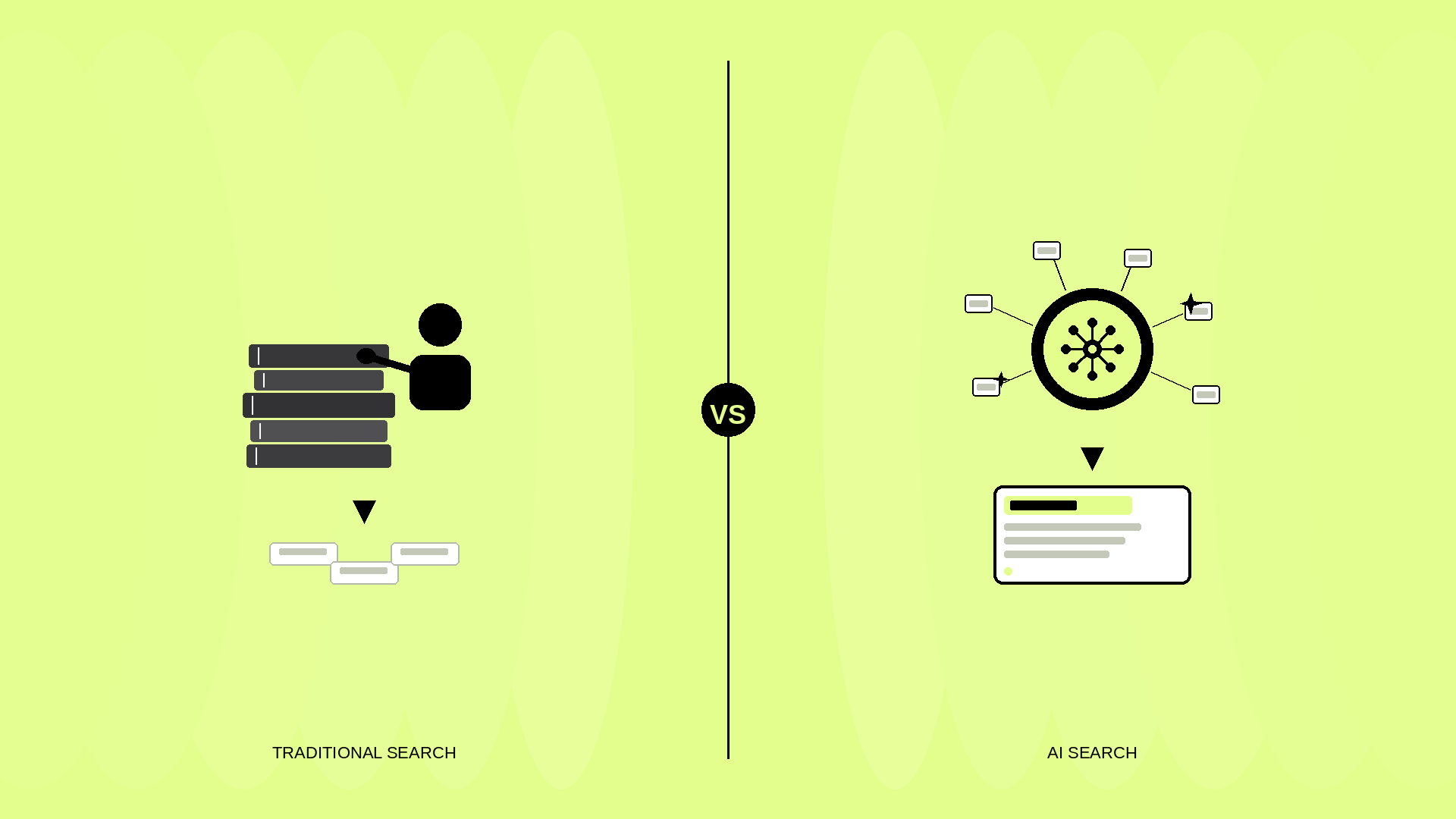
An LLM is an analyst.
You ask a question, and the analyst reads hundreds of sources, extracts the relevant data, and gives you a direct answer.
You do not need to trick the librarian anymore. You need to make sure the analyst finds your content first, and that your brand appears inside the sources the analyst trusts most.
AI uses vector embeddings to process text.
Every word and phrase is converted into a mathematical coordinate. Concepts that are mathematically close to the query get surfaced. Concepts that are far away do not.
A product description that says "comfortable winter shoe for cold conditions" is mathematically distant from "best studded running shoe for icy sidewalks at -5°C."
Another description that says "4mm carbide lugs, Gore-Tex membrane, rated to -15°C" is close. The AI pulls from proximity, not from your page rank alone.
Here, specificity is the mechanism.
Here is what actually changes your AI visibility. These are the tactics that drove results in the client data I presented at the talk.
Research shows 44.2% of all ChatGPT citations come from the first 30% of content. Do not bury your main point.
Answer the core question in the opening paragraph.
If your page is about Gore-Tex waterproofing, the first sentence should define what Gore-Tex waterproofing means for the buyer, not introduce your brand.
Break every article and product description into clear, single-idea sections.
One heading. One attribute. One paragraph. One answer.
If you mix waterproofing, grip performance, and temperature rating into a single product description paragraph, AI cannot extract any of them cleanly.
Separate them, and each becomes independently citable.
.png)
AI extracts structured data cleanly. Flowing prose descriptions of product specifications do not get reliably cited.
If you are comparing shipping costs, product materials, or size availability, put that information in a table.
When AI pulls that table into a user's answer, it links back to your page.
Stop writing vague descriptions.
Do not say "fast delivery."
Say "delivery within 48 hours to Estonia, Latvia, and Lithuania."
AI prioritises information gain. It looks for data it has not seen repeated across dozens of other pages. Give it something specific to extract.
Freshness matters more than volume.
Content updated in the last three months gets cited 20-30% more often than older material.
Instead of publishing ten new articles per month, update your highest-performing existing pages. Revise the data, sharpen the specifics, and update the publication date.
You cannot wait for AI to discover your website. You need to place your brand in the sources LLMs already trust.
Reddit is weighted heavily because it represents real human consensus. YouTube video transcripts are indexed and cited like articles. Quora reaches across 28 languages.
Niche review sites in your product category carry significant weight. The easiest tactic is getting your brand mentioned in a third-party "Top 10" listicle on a relevant niche site.
You do not need a backlink. The brand mention is enough. When a user asks AI for a recommendation, the AI reads that listicle and surfaces your brand.
Attribution in the AI era is broken. We call it the dark funnel.

A user asks ChatGPT which payment processor to use for a Baltic e-commerce store. ChatGPT mentions your brand.
The user opens a new tab, searches your company name directly, and lands on your site.
Your analytics records this as direct traffic or a branded search. You have no idea AI drove the sale.
Most attribution tools that claim to track AI visibility use API connections to query AI models. The results from an API query are completely different from what a real user sees. If a user changes one word in their prompt, the entire output changes.
The most reliable measurement method is self-attribution.
Add a required field to your checkout and contact forms: "How did you hear about us?" Include "AI assistant/ChatGPT/Perplexity" as a clear option. Set up a GA4 custom segment filtering for chatgpt, perplexity, gemini, and bing referral traffic.
Bing now routes Microsoft Copilot traffic, so that referral source is partly AI-driven. This gives you real data about where AI-influenced customers come from, without relying on proxy metrics.
These are the nine actions I would prioritise if I were running an e-commerce store right now.
Ask ChatGPT: "What are [your brand]'s key attributes?" The answer reflects how AI models currently understand you.
If the model describes you as budget-focused when you are premium, or as a local store when you ship internationally, that is a data problem. Find the sources the model is citing and correct the content on those pages.
Product names, prices, and availability must be accurate and current.
AI agents making purchases on behalf of users will pull from structured product feed data before they read your product page. If your feed is outdated, you are invisible to the agent at the moment of purchase intent.
Do not delete a product page when an item goes out of stock. Keep it live with updated availability information.
URLs accumulate citation authority over time. Deleting them resets that entirely. AI models that have learned to cite your product page will stop if the page disappears.
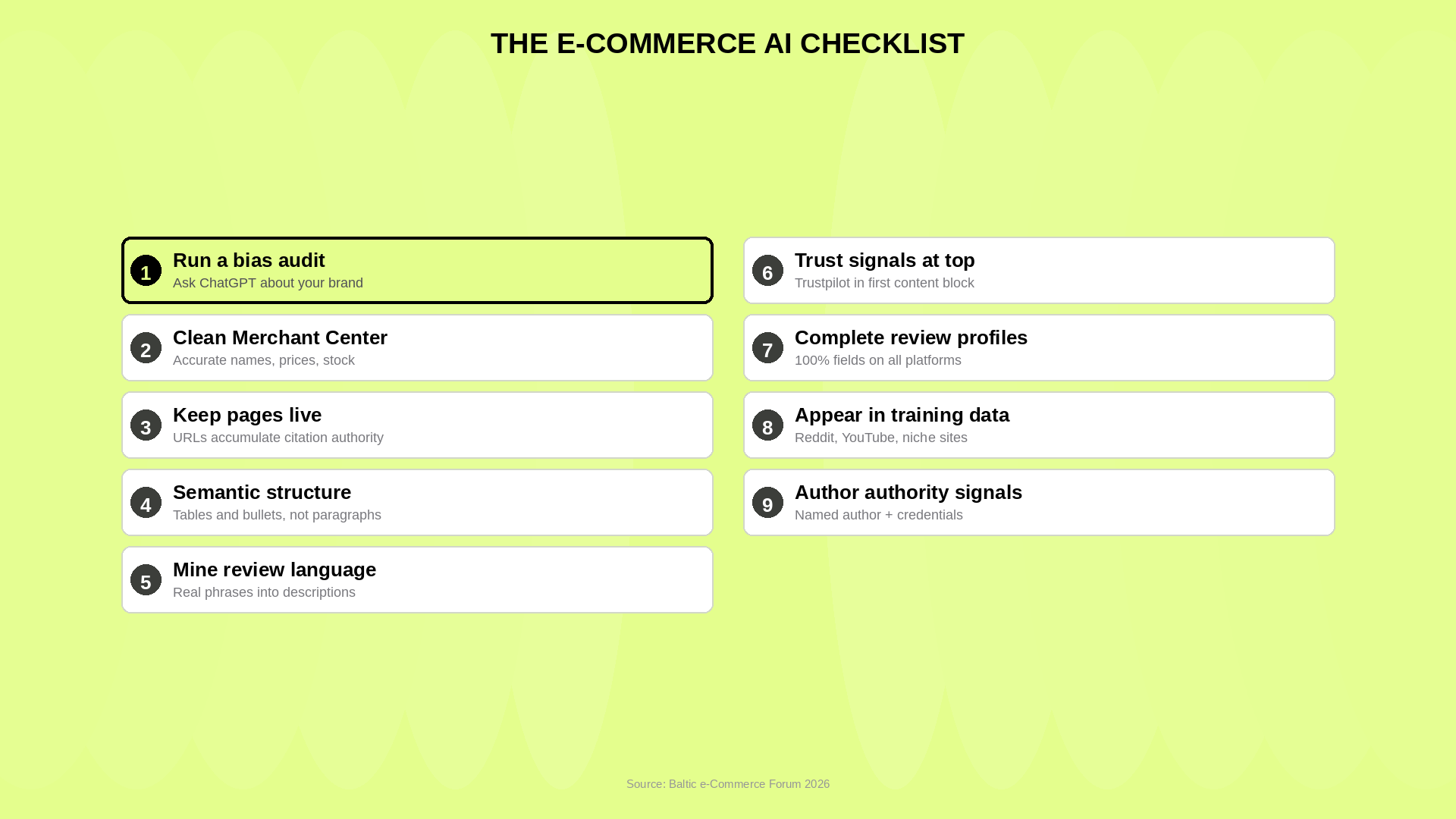
Product specifications belong in tables and bullet points, not paragraphs.
A bulleted list of materials, dimensions, and compatibility details is extractable. A paragraph describing the same information in flowing prose is not.
Pull the exact phrases real customers use in reviews. "Does not slip on wet tiles." "Warm enough for the Tallinn harbour walk in January." Put those phrases in your product descriptions.
These are the search terms people use when talking to AI assistants. Generic marketing language does not match how real users phrase their queries.
Put your Trustpilot rating and review count at the top of every product and category page. Not in the footer. Not on the About page.
AI models weight credibility signals when making purchase recommendations. Your rating needs to be in the first content block the model encounters.
Claim and verify your listings on Google, Trustpilot, and any platform relevant to your product category.
Fill every available profile field. These platforms appear in LLM training data. An incomplete profile signals an unserious business to both AI models and users.
Local blogs, Reddit communities, YouTube reviews, Quora answers, niche comparison sites. The more places your brand appears in genuinely useful context, the stronger the association in AI models.
Focus on the platforms that show up in your category's AI answers. Search for your product type in ChatGPT and Perplexity and note which sources they cite. Get your brand into those sources.
Do not publish articles anonymously. Include a named author, their credentials, and any relevant awards or recognition at the top of the page.
AI is lazy in one specific way asit may not scroll to the bottom of a long page to find credentials you buried in a bio. Put the expertise signal where the model will find it first.
We are preparing for what comes after search.
Soon, users will not type "best payment processor for Baltic e-commerce."
They will tell their AI assistant their monthly volume, their preferred currencies, and their integration requirements, and the agent will browse, compare, and select a provider on their behalf.
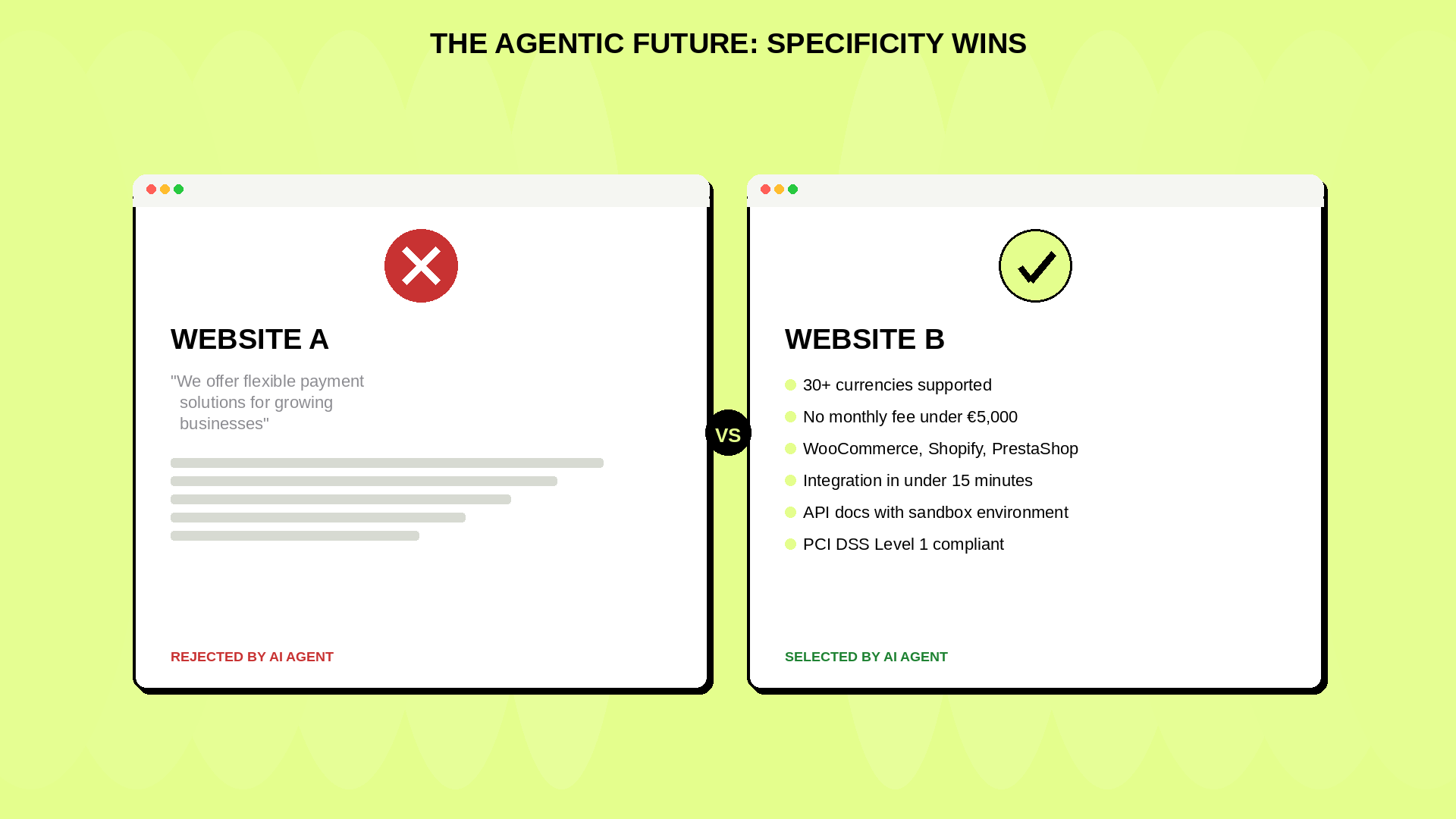
Website A will say "we offer flexible payment solutions for growing businesses."
Website B will say: Supports 30+ currencies. No monthly fee under €5,000 volume. Integrates with WooCommerce, Shopify, and PrestaShop in under 15 minutes.
The agent selects Website B. Website A is never considered.
The stores that survive this shift are not the ones with the best brand narrative. They are the ones that present machine-readable, specific, structured data at every touchpoint.
Do not hide. Be specific. Be the source of truth.


