


Most link building guides open by convincing you that link building works.
But if you are reading this, you probably already believe that. The question you actually have is, why did the last campaign not work?
Or, how do you make sure that your backlink campaign does not quietly waste your budget in the AI search era?
These are valid concerns, especially when your CFO is questioning whether link building even makes sense in a world where some of your buyers ask ChatGPT for recommendations before they ever open Google.
A good backlink is when a legitimate website with a strong audience links back to you. However, not all backlinks are made equal. There are some variations where backlink quality can be faked. Some fakes are sophisticated. Some are so cheap that Google's spam filters catch them before the invoice clears.
We have made link building campaigns for enterprise customers with $1 billion-plus funding rounds and for startups just getting their first pages indexed — so what follows comes from doing this, not theorizing about it.
This guide covers what the real version looks like, why it costs what it costs, and how to tell when a vendor is building something durable versus filling a deliverable.
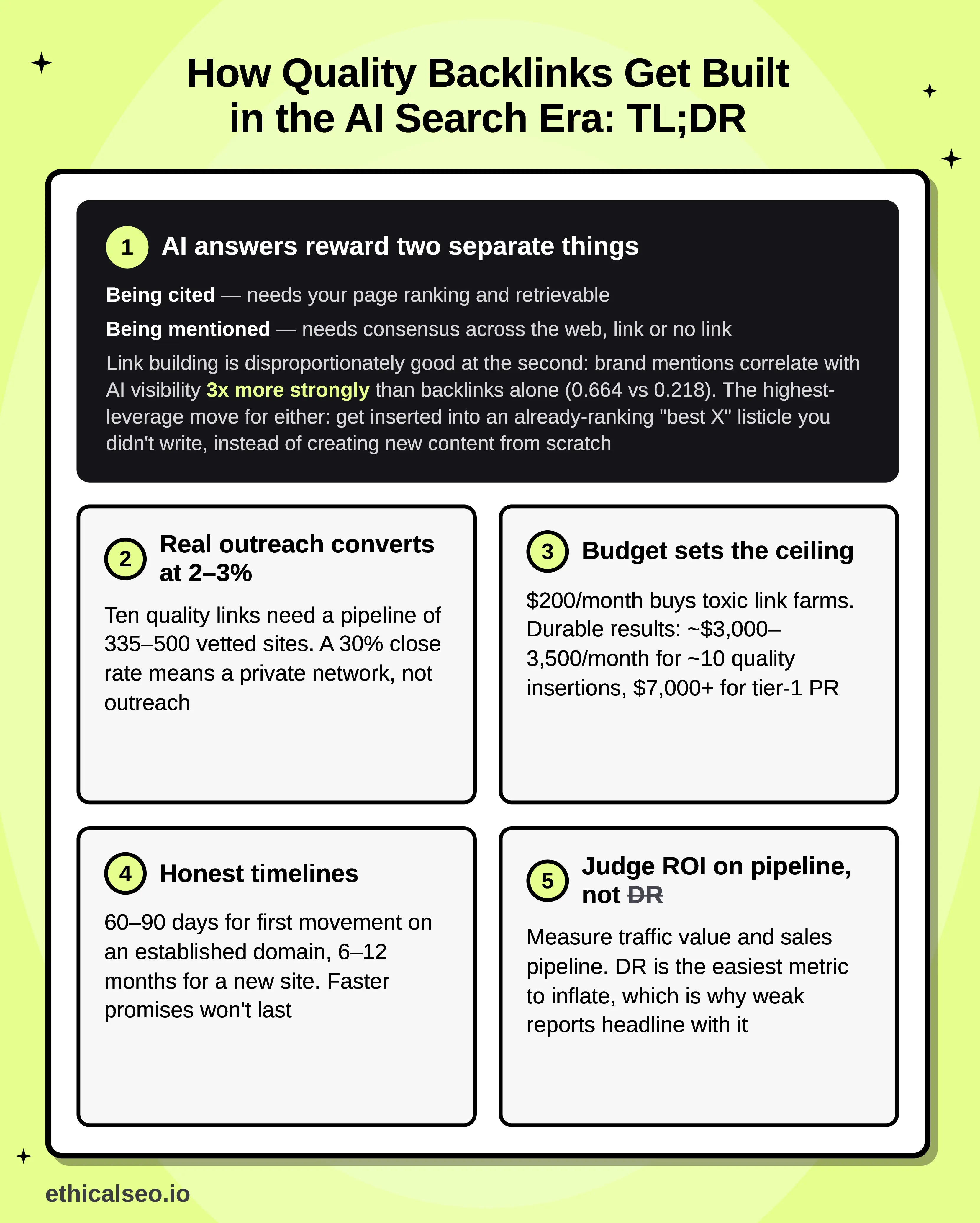
Before any tactic makes sense, two things need to be settled. What ethical link building actually is, and whether links still earn their keep in 2026.
The word ethical gets used so loosely in this industry that it has nearly stopped meaning anything.
Ethical link building does not simply mean no PBNs. It means refusing to deliver a placement you know is worthless just to hit a deliverable.
Every agency faces months where a target niche is difficult, publishers are slow, and the pipeline is thin. The choice at that point is to place something that technically counts as a backlink and bill for it, or to miss the deliverable and absorb the loss.
The risk with bought links is rarely a penalty, as it is silent.
Google’s spam detection system, SpamBrain, was trained specifically to identify unnatural links, and since the December 2022 link spam update, it catches both the sites buying links and the sites selling them. When it finds them, it does not usually punish anyone. It just stops counting the links.
Think about what that means for the budget. You pay, the link goes live, the report looks fine, and the link contributes nothing. Not a penalty. Not a warning. A wasted investment that looks like progress. Google’s spam policies spell out exactly what it treats as link spam, and the cheap end of the market checks nearly every box.
There is a second cost, as sites that exist to sell links also sell to gambling operators, pharma spammers, and worse. When Google detects one of these link farms, the whole domain loses value, and every link it sold loses value with it. Your link sinks with the ship it is standing on.
And even before Google acts, the profile is visible to humans. When a potential investor, enterprise prospect, or acquirer runs a backlink audit on your domain (and at due diligence stage, someone will), a profile full of link farm placements looks exactly like what it is.
A fair question to ask before spending anything is whether, with AI answers eating search results, do backlinks still matter?
They do. The evidence has not budged.
Backlinko’s analysis of 11.8 million Google search results found that the top result has, on average, 3.8 times more backlinks than positions 2 through 10. Ahrefs ran its own study on the impact of links and reached the same boring, reliable conclusion: pages with more quality referring domains rank better and earn more search traffic. No serious dataset has shown otherwise.
What has changed is that the second job links do. Ahrefs studied 75,000 brands across 76.7 million AI Overviews and found that brand web mentions correlate with AI visibility at 0.664, while raw backlinks sit at 0.218. Branded anchor text lands in between at 0.527.
It does not mean links stopped working. It says the mention around the link, the brand association it creates, now carries weight in a second arena of what ChatGPT, Gemini, and Google’s AI Overviews say when a buyer asks for recommendations.
A good placement in 2026 earns rankings and feeds the machines that answer your buyers’ questions. A bad placement earns neither.
That is the case for the budget line. Now let’s check whether your site can actually use it.
Do the groundwork to check whether your website is ready for links, and which of your pages should receive them. Skipping this stage is how companies end up buying sixty links to a page that never moves.
Links cannot fix a broken site. Most people learn this the expensive way.
One of our clients had indexable articles, but the canonical tag on each one pointed to a URL that did not exist. The site was telling Google “index this” and “this is not the real page, and the real page is missing” at the same time. No number of backlinks can compensate for that.
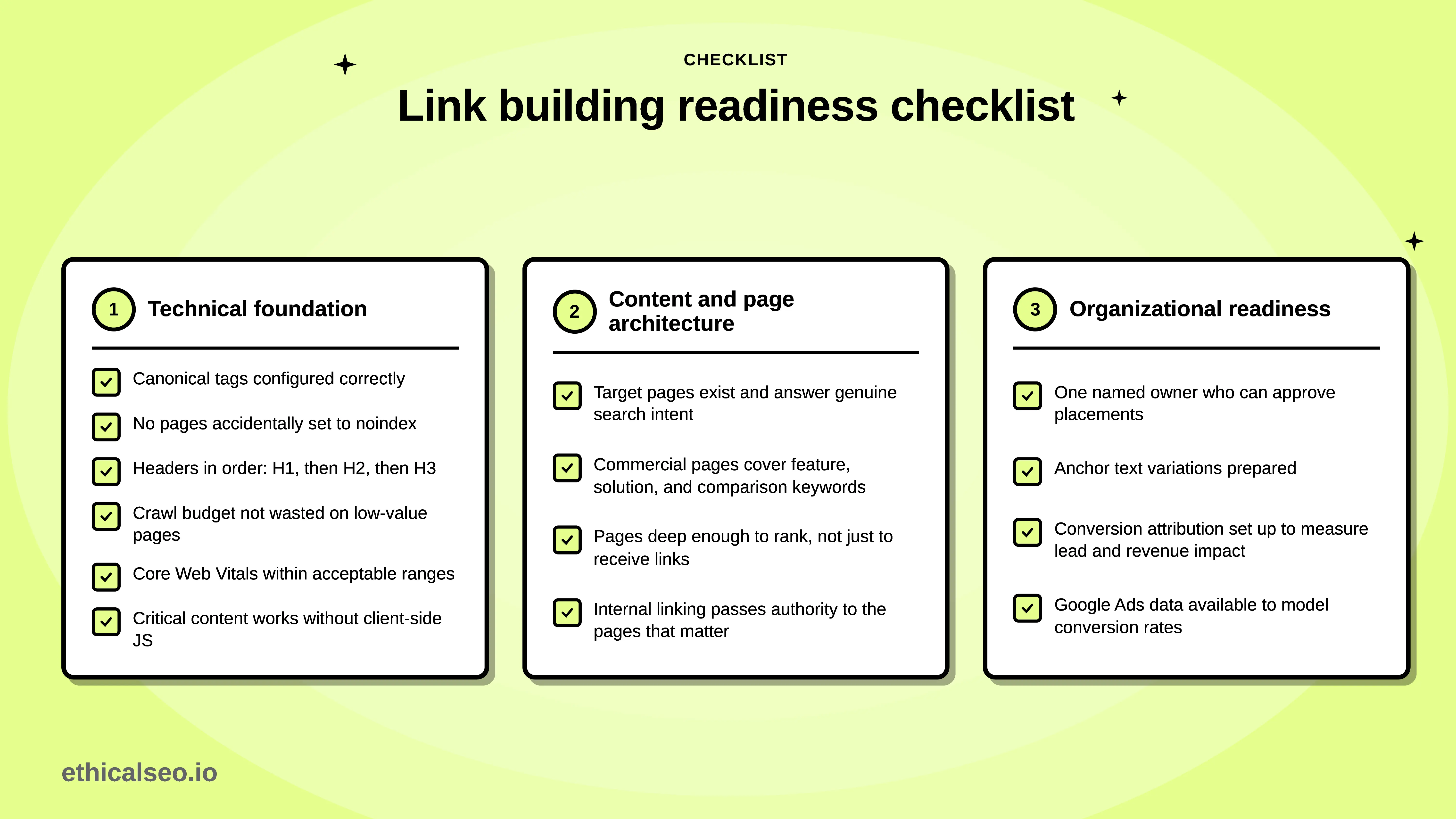
You’ve got to fix first and build second. So, before a campaign starts, check three areas.
If two or more items on the technical list fail, pause the link conversation and fix the site.
Before adding anything new, look at what you already have. Your audit answers how large the gap is between you and the competitors who outrank you, whether you are missing link equity, and why your previous link-building campaigns might have failed.
Pull a full export from Ahrefs or Semrush and check the quality of the referring domains you have in your backlink profile
Check out our detailed video breaking down 11 key ways to evaluate backlink quality.
There are also more advanced ways to look at your existing backlink profile, like
So if you see that the majority of your links came from spammy, low-value websites, this might be one reason your results aren’t improving.
One more thing your audit must account for is that links die constantly. Ahrefs found that at least 66.5% of links created over the previous nine years are dead. Site redesigns, content consolidation, and lapsed domains. Whatever your link count was two years ago, it is smaller now. So, make maintenance and routine checks a part of the job.
Your audit findings feed four decisions:
Here is a typical example of the competitor gap analysis we do as a starting point for any collaboration

This audit reveals the growth potential a company can achieve in traffic and overall traffic value. It highlights the gaps in Domain Rating (the website's authority measured by Ahrefs), the number of pages needed, and the high-quality backlinks required to compete. Ultimately, these insights allow us to accurately estimate the potential investment and its return.
Most campaigns fail before outreach starts because they point good links to the wrong pages.
There are two separate page decisions in link building. The first is which page on your own website receives links. The second, which page on someone else’s website hosts the link, comes later, once outreach begins. Different decisions, different criteria.
Across our campaigns, links get distributed across three buckets, in roughly equal measure:
The balance matters because a profile where every link points to money pages looks engineered, and real popularity is a bit more complex than that.
Within that distribution, the best target pages are commercial pages with growth potential, meaning pages that already rank for their keywords somewhere in positions 5 through 30. Second best are informational pages with the same kind of potential.
Why those? A page sitting in positions 5 through 30 has already convinced Google it belongs in the conversation. A strong new referring domain can move it into the positions where clicks actually happen. You are accelerating something that is already in motion.
The Practical Method
.webp)
1. Export organic keywords:
Export your organic keywords from Ahrefs or Semrush.
2. Filter by ranking position:
Filter the list for keywords currently sitting in positions 5 through 30 (your striking-distance keywords).
3. Prioritize commercial intent:
Prioritize the commercial pages on that list to ensure you are targeting high-value traffic.
4. Evaluate competitor authority:
Check whether your pages can realistically compete based on Domain Rating (DR). Ideally, you want to see top-ranking competitors with a DR similar to or lower than your own.
5. Calculate backlink gaps:
Once viability is confirmed, look at the number of referring domains pointing to the top competing pages. This gives you a clear target for how many unique backlinks you need to build for your page.
6. Assess traffic and ROI potential:
Finally, verify that the potential traffic gain makes financial sense. Sometimes, pushing a page higher won't yield enough return to justify the investment, so always calculate the upside first.
These pages become link targets, and the identified keywords feed the anchor pool
A page with no rankings, no traffic, and no search intent match will not come alive because you pointed links at it. We have watched a company build around 60 links to a single page that showed no movement at all, month after month. The links were not the problem; the page was.
Link impact arrives with a delay. In our campaigns, movement from a batch of links typically shows in the second or third month. So the process is building links to a page, monitoring its response for 2 to 3 months, then either scaling what is working or stopping and diagnosing the page.
Pouring links into a page that has shown nothing after a full quarter is counterproductive.
RemoFirst followed exactly this discipline. Over 18 months, we built 136 links to 28 target pages, checked traffic response every few months, and used that signal to decide where to keep pushing.
Ten of those 28 pages had been live for 5 to 36 months with close to zero traffic before we touched them; the content was fine, the backlink authority was not. After the campaign, traffic on those pages moved from 436 to 3,663 monthly visits, and site-wide organic grew 478%, from 9,200 to 53,300 visits.

By the end of this part, you will understand the process well enough to interrogate any vendor and to know which questions expose the shortcuts.
The workflow from the first call to the first live link has more stages than most clients expect.
The engagement starts with a competitive gap analysis. Using Ahrefs or Semrush, the team pulls the top three to five organic competitors for your priority keywords. Not the industry names you think of as competitors. The sites are actually ranking for the terms you want.
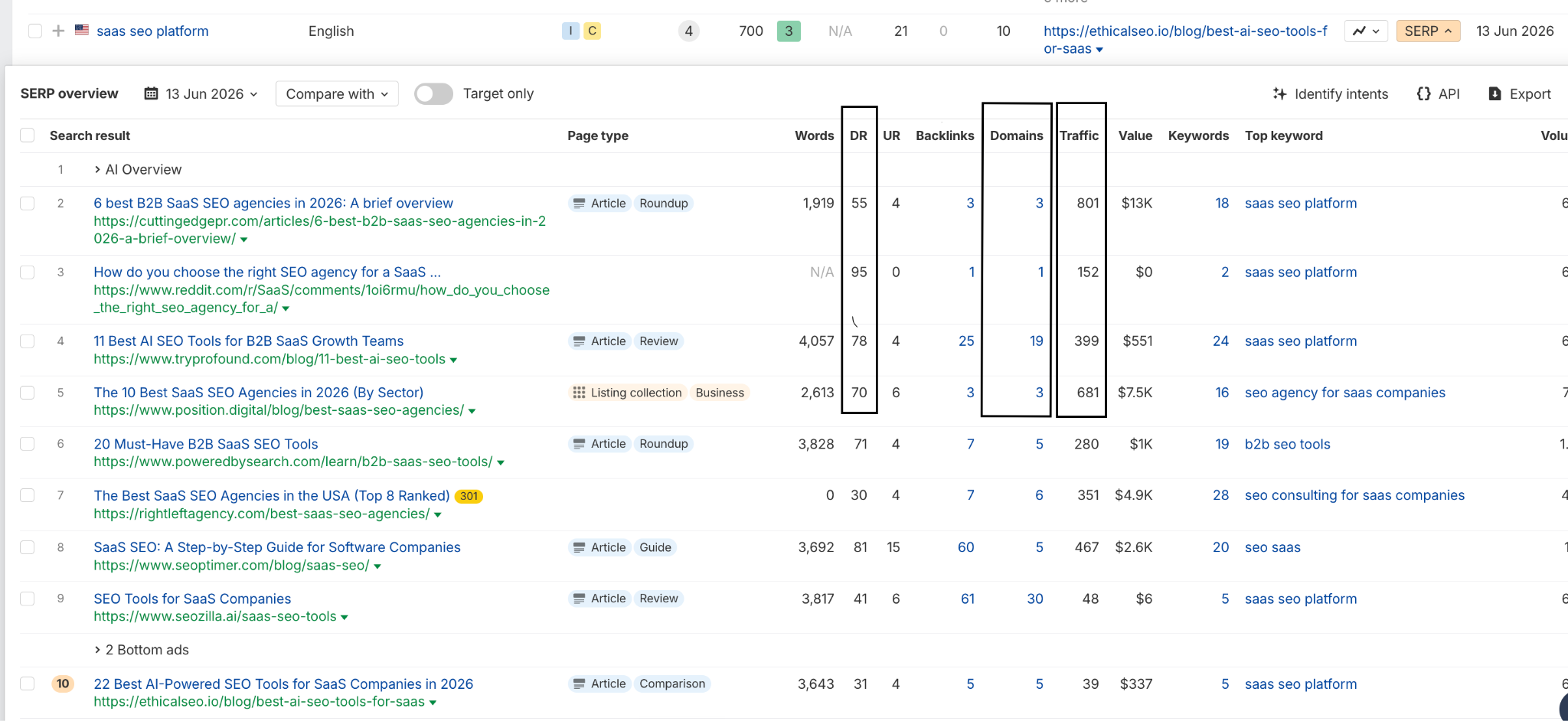
The analysis pulls referring domain counts for the top-ranking pages, filters those domains through quality criteria, and compares what remains against your current backlink count. If the top-ranking page has 30 quality backlinks and yours has 8, the gap is 22. How fast competitors keep building determines how aggressively that gap needs to be closed.
This is where the page selection work happens in practice, before any outreach. Commercial pages with keywords in positions 5 through 30 first, no dead pages, and distribution across the home page, commercial, and informational pages as we discussed earlier.
A few operational pieces go in place before the first email:
The team builds a pipeline of sites that are topically aligned with your content and pass the donor quality checklist.
Let’s assume you want to build links to a page about video editing software.
Every link builder reviews the quality guidelines before any outreach begins, and sites that agree to a placement go through a second-layer quality review.
If you want approval rights over placements, the vetted list comes to you before anything goes live. You only see sites that have already cleared our internal reviews.
Guest posts extend the chain by reaching out for target site approval, then for article title approval, then for finished article approval, then for submission.
Each handoff adds days, which is why a guest post realistically takes three weeks or more from pitch to publication. Build that into the timeline expectations from day one, and the process stops feeling slow and starts feeling honest.
Anchor text is the visible, clickable words a link lives in. It is one of the most mechanical parts of link building and is equally important.
Every target page needs at least 10 to 15 anchor variations prepared before outreach starts. Here is why.
When you are negotiating placements with ten different site owners, some negotiations remove options. The publisher may want different wording, or the paragraph could only fit a certain phrase. If your anchor pool is too small, some links will inevitably ship with identical anchor text. Identical anchors across placements are one of the easiest artificial patterns for Google to spot.
Google’s own guidance describes good anchor text as descriptive, reasonably concise, and natural. Cramming keywords into anchors sits explicitly on its spam list.
An anchor that uses your brand name (“According to XYZ’s benchmark data”) does two jobs. It diversifies your backlink profile, and it builds the brand association that AI systems learn from. In Ahrefs’ 75,000-brand study, branded anchors correlate with AI visibility at 0.527, more than twice the strength of backlinks alone. LLMs pull brand associations from the text around links. Branded anchors are how you feed them on purpose.
The donor site is the website where your link will live. This is the other half of the page decision, and it is where quality is won or lost.
You will probably never qualify donor sites yourself. But you should know exactly what your agency checks. Here is our actual checklist, the one every Ethical SEO link builder applies before a site enters the pipeline:
A quality site can still host your link on a page nobody visits, and Google barely crawls. The page-level check matters as much as the domain-level one.
Three tactics produce the most quality links. They differ in speed, cost, and what you get beyond the link. The figures below reflect what we see in the market and in our own campaigns in 2026:
A niche edit places your link inside an already-published article. The page is indexed, often has traffic, and there is no content production cycle, so it is the workhorse for monthly targets.
One rule that distinguishes a clean insertion from an obvious one is that when a link is added to an old article, the article gets updated, too. The update should also give Google a reason to recrawl the page and register the link as an editorial addition.
A guest post is a new article written for someone else’s site. Here, we don’t mean cheap link farms you can buy on any link-building marketplace for 50-200 bucks, but rather links on legit websites. For instance, here is the guest post we published on G2.com. You have to understand that paid guest posts mostly exist for shady niches like casino, as they don't have any other option but to buy their placements.
Done properly, it starts with a keyword gap analysis to find a topic the publisher’s audience wants, the publisher can rank for, and your brand belongs in. That overlap is what makes a publisher accept a pitch without payment, and it is the step paid-placement vendors skip entirely.
The format worth paying extra for is the listicle. A position in a “best X software” article on a third-party site that ranks for commercial keywords earns a backlink, puts your brand in front of buyers mid-evaluation, and creates exactly the kind of structured comparison content that LLMs cite when asked for category recommendations. This one placement, when done perfectly, can offer you three returns.
Digital PR earns mentions in major publications through newsworthy data, original research, or expert commentary, instead of paying five figures for sponsored coverage. The links tend to be the highest authority available, and the brand mentions feed the entity signals that AI search runs on. It is the right add-on when brand visibility is a stated goal. However, it does not replace the tactics mentioned above.
Please note there is a lot of fake PR happening as well, where it is just publishing guest posts on cheap paid media and pretending it has been covered naturally by a journalist.
Link insertions are the baseline volume. Guest post selectively, where topical context and listicle positioning justify the cost. Digital PR on top, when the goal includes brand entity building.
What to budget, and how long to hold your nerve before judging results. This is the part to read twice before signing anything.
Across Ethical SEO campaigns, manual outreach converts at roughly 2 to 3% of prospected sites. Landing 10 quality links means working a pipeline of roughly 335 to 500 prospects. Not 20. Not 50. Hundreds, each one researched, qualified against the checklist, contacted, and followed up.
Authority Hacker analyzed 600,000 outreach emails across 150,000 websites and earned 4,300 referring domains, about 2.9% of sites contacted, and under 1% per email sent. Independent dataset, same answer.
As each campaign is different, some niches may convert above that range, and some campaigns may last longer.
What this math shows is that real outreach at 2 to 3% requires research time, qualified writers, follow-up cycles, and quality review. When a vendor’s price implies they close one of every three emails, they are not better at outreach than everyone else. They are skipping the outreach and placing links in a network they control. You now know exactly what question to ask them.
Of course, as we work through the years, we build good connections with legit websites and their editors, but this isn't very scalable, so outreach is the only ethical way to do it. For some of our enterprise-level customers (for instance, one had a single funding round of 1+ billion USD) we had to build 50 links per month.
Marketing budgets average 7.7% of company revenue, per Gartner’s 2025 CMO Spend Survey, and every line inside that number is fighting for its life. So let us make the link-building line defensible.
What different budgets realistically buy:
A service charging $200 per month is not running that outreach math. It cannot. At real outreach conversion rates, $200 does not cover the research time for a single quality placement, let alone the placement.
What you get instead is a link farm network or forum drops. And you already know how that story ends. SpamBrain catalogs the network, the links get devalued silently, and the farm domains decay within a few years, taking your “link equity” with them. Such services cost $200 every month you run them, plus the time you lose not building anything real.
If the budget only supports $200 a month, do not buy links at all. Spend it on content and collect the links your best pages earn on their own.
It may take 60 to 90 days before the first measurable movement is visible, assuming an established domain and moderate competition. Anyone promising faster is promising something they do not control.
The independent data agrees. Authority Hacker’s survey of link builders found 46.6% see ranking impact within 1 to 3 months, and another 35.2% within 3 to 6 months, with the overall average around 3.1 months.
By scenario:
If a page has received consistent quality links for several months with zero movement, the problem is probably not the links.
The usual culprits are thin content on the target page, a weak search-intent match, technical issues like a canonical tag pointing nowhere, or internal linking that starves the page. As more links will not fix a structural problem, fix the page before starting your campaigns.
The final stretch is whether your vendor is still earning the retainer, which numbers in their reports mean anything, and how the AI shift changes what you ask for.
The fundamentals have not changed. A natural profile has links from a variety of real domains, a mix of anchor types (branded, descriptive, keyword), brand mentions alongside the links, and a growth pace that matches the site’s traffic and publishing activity. A startup with 200 monthly visitors does not naturally collect 100 referring domains in a month, and Google calibrates for exactly that.
The bar for what counts as a real website has risen. It must have real traffic, a consistent publishing history, an identifiable editorial team, and content that exists for readers.
And because links die constantly, a natural profile in 2026 is maintained, and ongoing replacement should be a part of that.
For a site at that scale — light traffic, early-stage backlink profile — we recommend a 5-backlink-per-month pace, with a gradual increase once you generate higher monthly traffic.
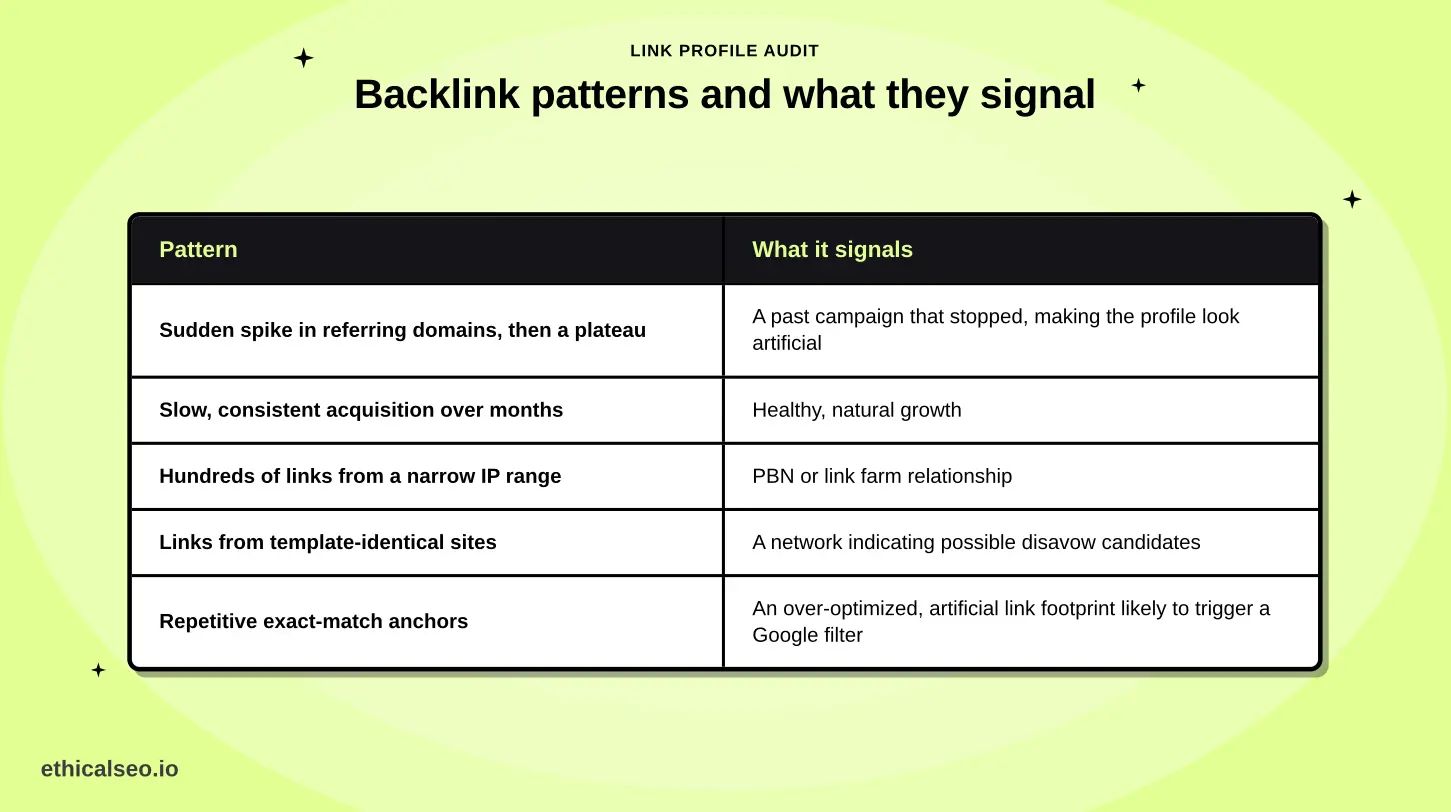
Quality decay shows up in operations before it shows up in rankings. Here are key patterns to watch.
.webp)
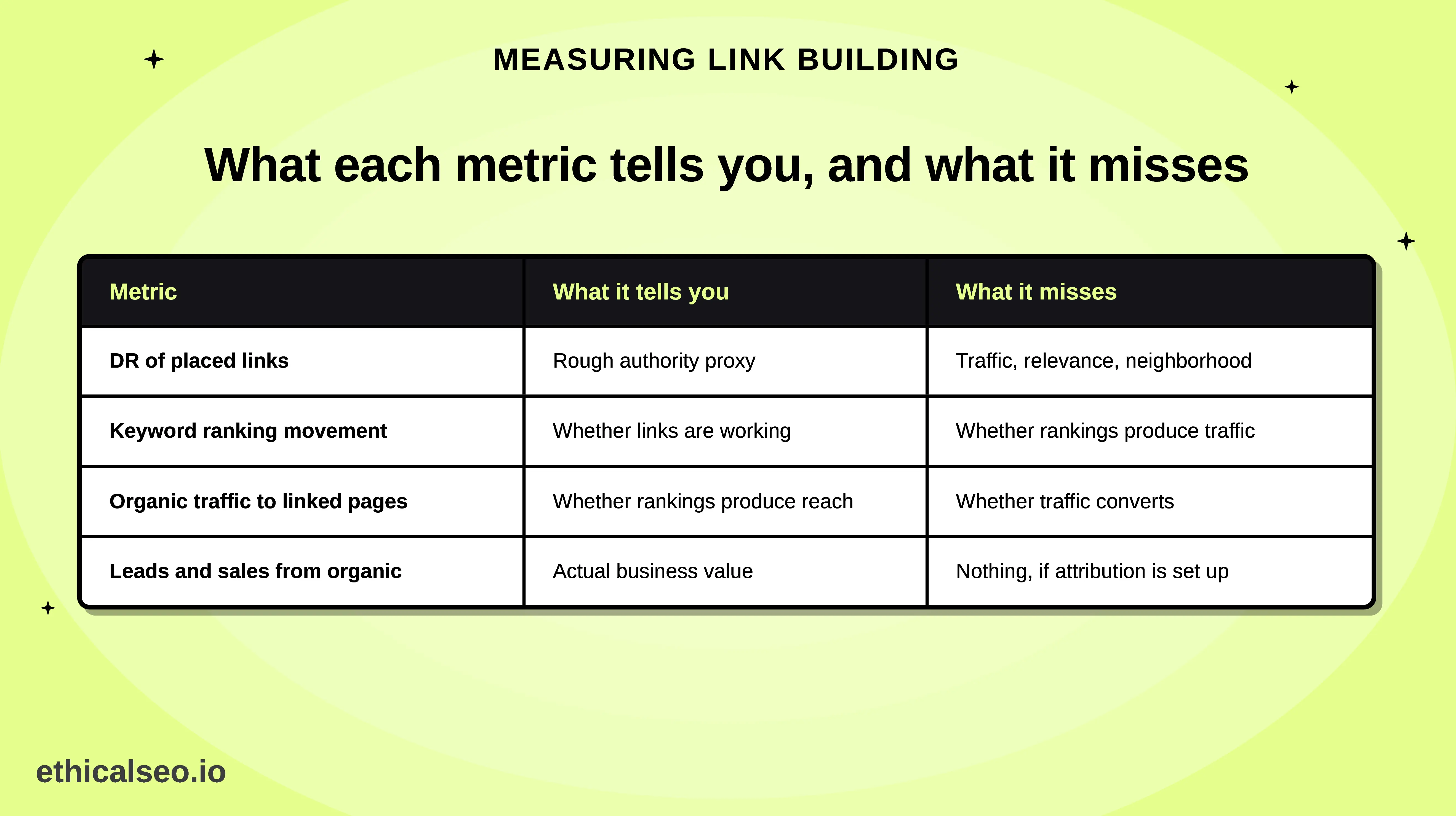
Four metrics, tracked together, tell you whether link building is working. Each covers a blind spot of the other.
The faked one is the Domain Rating of the placed links. It is the easiest number to inflate, which is why it headlines weak reports.
Your buyers are already asking ChatGPT what to shortlist. Your brand can show up in that answer in two distinct ways, and link building feeds both differently.

Citation is when the AI response links directly to one of your pages as a source — the footnoted links you see in Perplexity, Google AI Overviews, or ChatGPT's browsing mode. This depends on live retrieval: the system has to find and trust your page enough to pull it into that specific answer, which is why classic ranking authority still plays a role here.
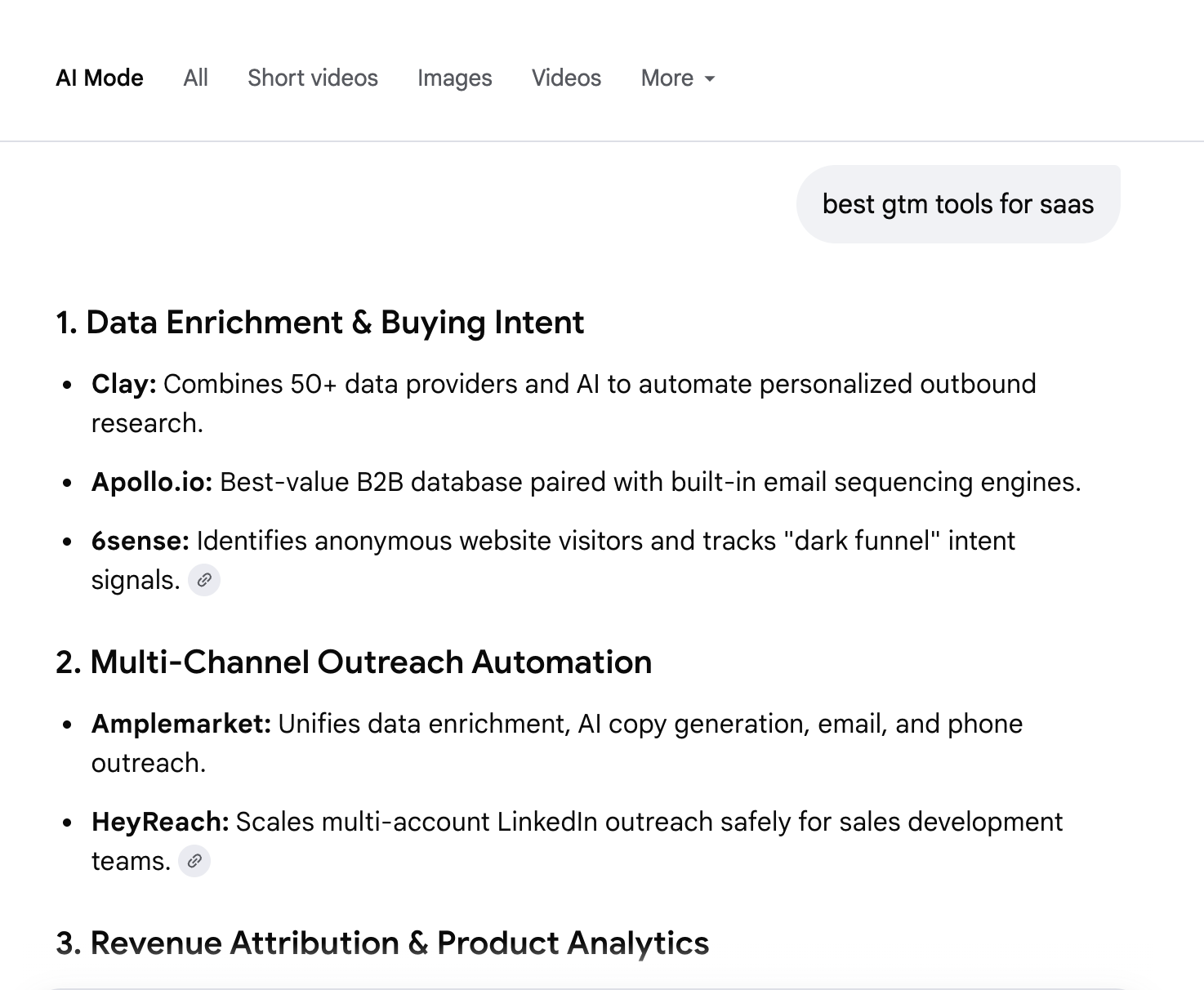
Brand mention is different: the model names your brand in its answer, with or without a link, because it has learned to associate your brand with that topic from the web it draws on. This does not require your page to win a retrieval race. It requires enough of the web to already agree on who you are. (For the deeper mechanics of how retrieval-based and training-based AI answers actually work, see [our LLM guide — link needed].)
Wallester, a fintech card-issuing platform we have worked with for a year, has already seen this shift show up in their own numbers:
"In the year that we've been working together, we've seen a 796% rise in traffic from LLMs — which is not a bad result." Justin Zehmke

Ahrefs’ 75,000-brand study found brand web mentions correlate with AI visibility at 0.664, three times the 0.218 correlation of backlinks alone. And Semrush’s ghost citations study found AI engines frequently cite a source without naming the brand, or name it without linking. The practical takeaway here is to negotiate placements where your brand is named and described, not just hyperlinked. The copy surrounding your brand name becomes the asset here.
When the paragraph around your link reads like a direct answer to a question a buyer would ask, it stands a better chance of being pulled into an AI overview or LLM response. This applies to your own content and to the copy you ask publishers to place around your links.
If every site that mentions your brand describes it differently, the signal is noise. If many sources consistently associate your brand with the same category, use cases, and differentiators, models learn what your brand is. That consistency, built placement by placement, is what AI-visibility link building actually optimizes for.
Third-party listicles are the highest-value vehicle here. One warning about the self-serve version of that idea is that publishing “best X software” articles on your own blog, with yourself ranked first, is now a documented way to lose traffic.
After recent core updates, Search Engine Land reported organic visibility drops of 30 to 50% at SaaS brands that leaned on self-promotional listicles. Get ranked in other people’s lists. Stop crowning yourself in your own.
Vespia, a compliance and KYB verification SaaS, came to Ethical SEO with no meaningful organic traffic, no organic leads, and a domain that could not compete in its target categories. The plan was nothing exotic.
We built the technical foundation first. Then, create content aimed at the commercial keywords that their buyers actually searched. Once that is done, links are built to pages with growth potential, distributed across the home page, commercial, and supporting pages, with early listicle placements to establish the brand in comparison contexts.
The result was inbound leads from organizations at the level of MasterCard, and eventually an acquisition by Veriff, the KYC unicorn, in February 2026. The attribution was clean enough to serve as the model on which this guide is built.
The pattern holds in both directions. When campaigns fail, the autopsy almost always finds links pointing to pages with structural problems or to a site that skipped the upstream work.
So, in a nutshell, invest in backlinking if your category has the opportunity, fix your site before the first placement, pay what the outreach math actually costs, and judge your vendor on traffic and leads, never on DR alone.
If you’re ready to kick off your backlink campaign, view our AI SEO and link-building services and sign up today to get the discussion started.


