


Somewhere today, a buyer in your category typed their problem into ChatGPT and got back a shortlist of three or four brands.
Ever wondered how these brands end up on the shortlist?
By showing up in the sources AI reads, describing themselves consistently across the web, and publishing pages a model can quote.
All of these signals can be built deliberately. And that’s precisely what this guide is all about.
If you lead marketing or growth at a B2B software company, it will show you:
A good way to start is to ask ChatGPT to recommend software in your category and run the prompt a few times (logged out and incognito). Whatever you see is your baseline, and everything after this page is about improving it.
Here is what the outcome looks like when it works.
One of our clients saw a 796% rise in referral traffic from LLMs (ChatGPT, Perplexity, Claude, and more) in the year we worked together. It was the result of AI optimized content, training data influence (a variation of link building), and social signals combined into one system.
In this guide, we cover what AI search changes and what it doesn't, why brand mentions matter more than citations, the diagnostic we run before touching any content, the writing and distribution playbook, and the numbers you can defend in front of a CFO.
Before any tactic makes sense, you need an accurate map. How big is AI search really? What do the words mean, and what should you actually be optimizing for?
Let's start with the number that puts everything else in context.
According to Search Engine Land, Google still drives roughly 95% of your organic traffic. AI search sits around 5%. What’s more, nearly 95% of ChatGPT users still visited Google.
This shows that people ask ChatGPT for directions, then go to Google to verify and compare, making AI search an additional layer on top of search behaviour.
And so, a citation in ChatGPT does not yet replace the ranking for the commercial terms. The data above is why this guide treats AI visibility as a layer on top of SEO.
Here's what actually changed. Behaviour.
Neil Patel more recent analysis, tracking 60 campaigns through June 2026, found an even wider gap: AI-referred visitors converting at 5.97% against 0.72% for traditional traffic — 8.3 times higher, and closing 62% faster.How does this happen? The user refined their needs inside the conversation before they clicked. By the time they land on your site, half the conversation has already happened.

AI search is a small fraction of traffic but has an outsized share of buying intent, and that share is growing. Top-of-funnel informational traffic is being eaten first because that's exactly what an AI answer replaces.
The brands building their AI visibility now are the ones that will own the answers when the fraction is no longer small.
You'll see three acronyms thrown around, often interchangeably. However, they are not interchangeable.
AEO (Answer Engine Optimization) and GEO (Generative Engine Optimization) both optimize content for AI-driven search, but with different goals.
We call the whole discipline AI SEO (GEO), and the "SEO" part is deliberate, as this work sits on top of foundational SEO.
Traditional Google is a librarian who hands you a stack of ten books (like 10 blue links in search results) and says, "figure it out." An AI engine is a librarian who reads all the books, synthesizes them, and gives you one answer. Your job used to be getting your book on the shelf. Now it's also making sure the librarian trusts your book enough to quote it.
And here is the part that changes how you measure everything, as you don't rank in LLMs only appear.
An LLM is a probability machine. Type the same prompt twice, and you can get two different brand lists. SparkToro had 600 volunteers run the same brand-recommendation prompts through ChatGPT, Claude, and Google's AI a combined 2,961 times. The chance of getting the same list of brands in any two responses was under 1%.
So when a tool tells you "your brand is #3 in ChatGPT," it is just a snapshot of one random answer. The real metric is how often you appear across many runs, and you’ll learn how to measure that properly in our subsequent chapters.
There are two fundamentally different mechanics by which your brand ends up in an AI answer.
The first is retrieval (RAG): the system searches the live web in real time, finds relevant pages, and uses them to construct an answer. This is a real-time race where classic ranking authority dictates whether you get cited as a footnoted link or recommended based on fresh data. As Lily Ray, VP of SEO & AI Search at Amsive, puts it:
"Every major AI search product relies on RAG (retrieval-augmented generation), which means live retrieval is dependent on positioning well within search engines. If your organic visibility dips, your AI search visibility will follow, as language models are less likely to retrieve your content."
The second is parametric memory (training): the model has already learned to associate your brand with a topic from its training data, naming and recommending you natively - even with browsing turned off. This doesn't require winning a live race; it requires enough of the web to have agreed on who you are long before the prompt was typed.
Citations only happen through retrieval. But mentions and recommendations can come from either mechanic - synthesized live from search results or pulled natively from training. The holy grail of AI search isn't just winning the real-time retrieval race, but becoming part of the model's core knowledge.
Three things can happen to your brand inside an AI answer, and they are worth very different amounts.
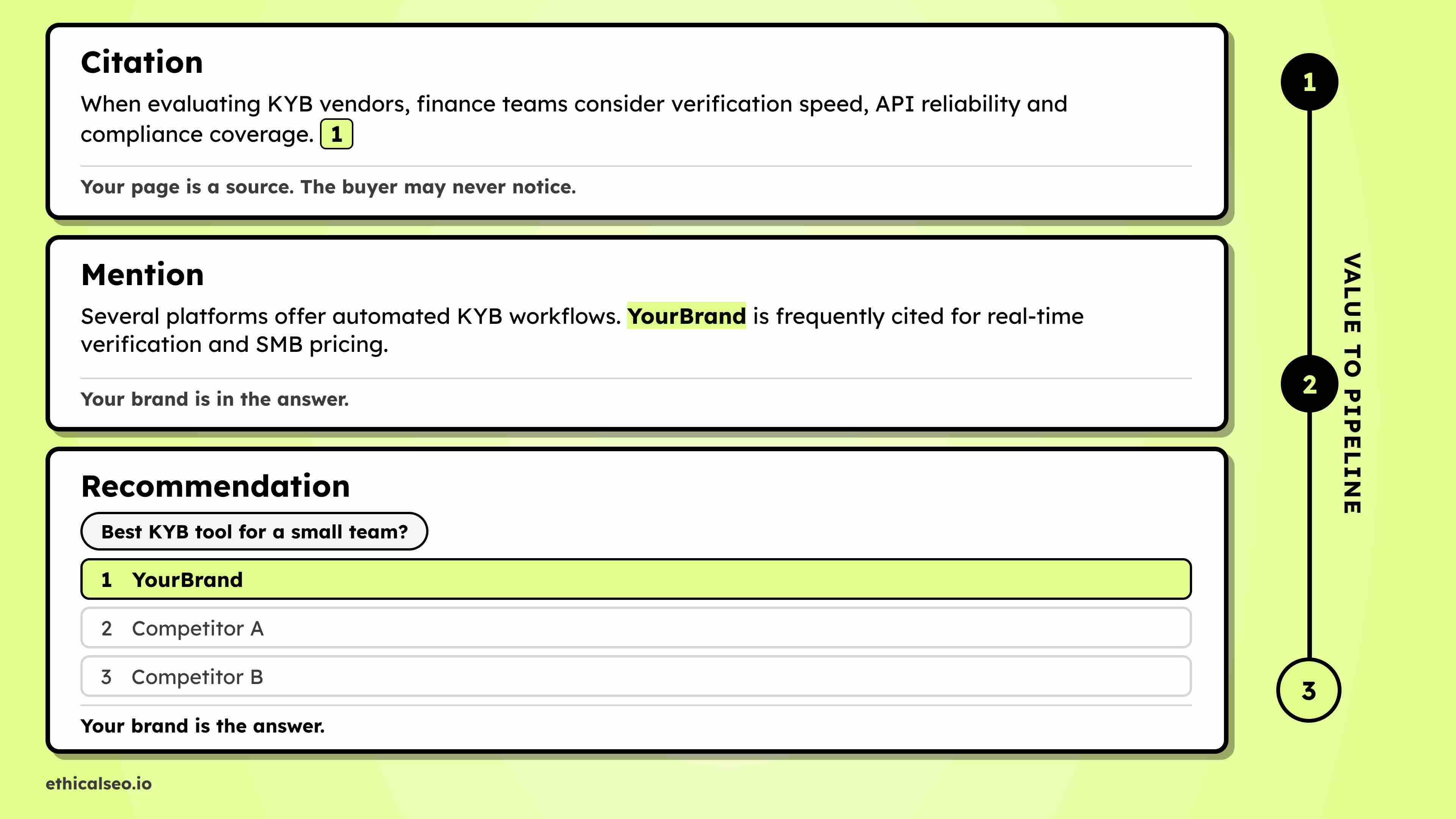
Track all three. Prioritize mentions and recommendations. Because a citation by itself doesn't do much, since it's just a source.
And even that is rare: according to Similarweb even after climbing more than fivefold over the past year, the share of ChatGPT answers that include an actual citation reached just 6.8% by May 2026 — 6.6% in the technology category specifically.
However, mentions are what AI pays attention to. Ahrefs studied 75,000 brands to find out what predicts whether a brand shows up in AI Overviews. The strongest component happened to be how often the brand is mentioned across the web.
.jpg)
It mattered three times as much as backlinks. In other words, the models learn who you are from how often people talk about you, not from who links to you. On the other hand, a recommendation is where the pipeline lives.
So the goal of everything that follows is all about becoming the brand in the answer when your buyer requests a recommendation.
And to get there, you need to go beyond just being a result and become the answer.
The diagnostic below is where AI visibility is actually won or lost, and it costs nothing to run. You don’t need new content or tools, just clear answers to a handful of questions.
Companies struggling with AI visibility rarely have an AEO problem, but most of them have a clear brand positioning problem.
Our work across B2B SaaS clients keeps confirming the same thing. Brand selection depends on whether the market, your website, your customers, and third-party sources all tell the same story about why your brand belongs in the answer.
Why does the same story matter so much?
Because an LLM builds its picture of you from everything it reads. When the information about you is consistent across the internet, the AI understands who you are. Your entity. When your homepage says "revenue intelligence platform," a review site says "sales analytics tool," and a listicle says "CRM add-on," the model has three weak signals instead of one strong one.
Consensus is the mechanism, and consistency is the work.
Before writing a single new page, answer five questions:
If two or more answers are no, fix positioning before tactics. Links and content pointed at a fuzzy entity build fuzzy visibility.
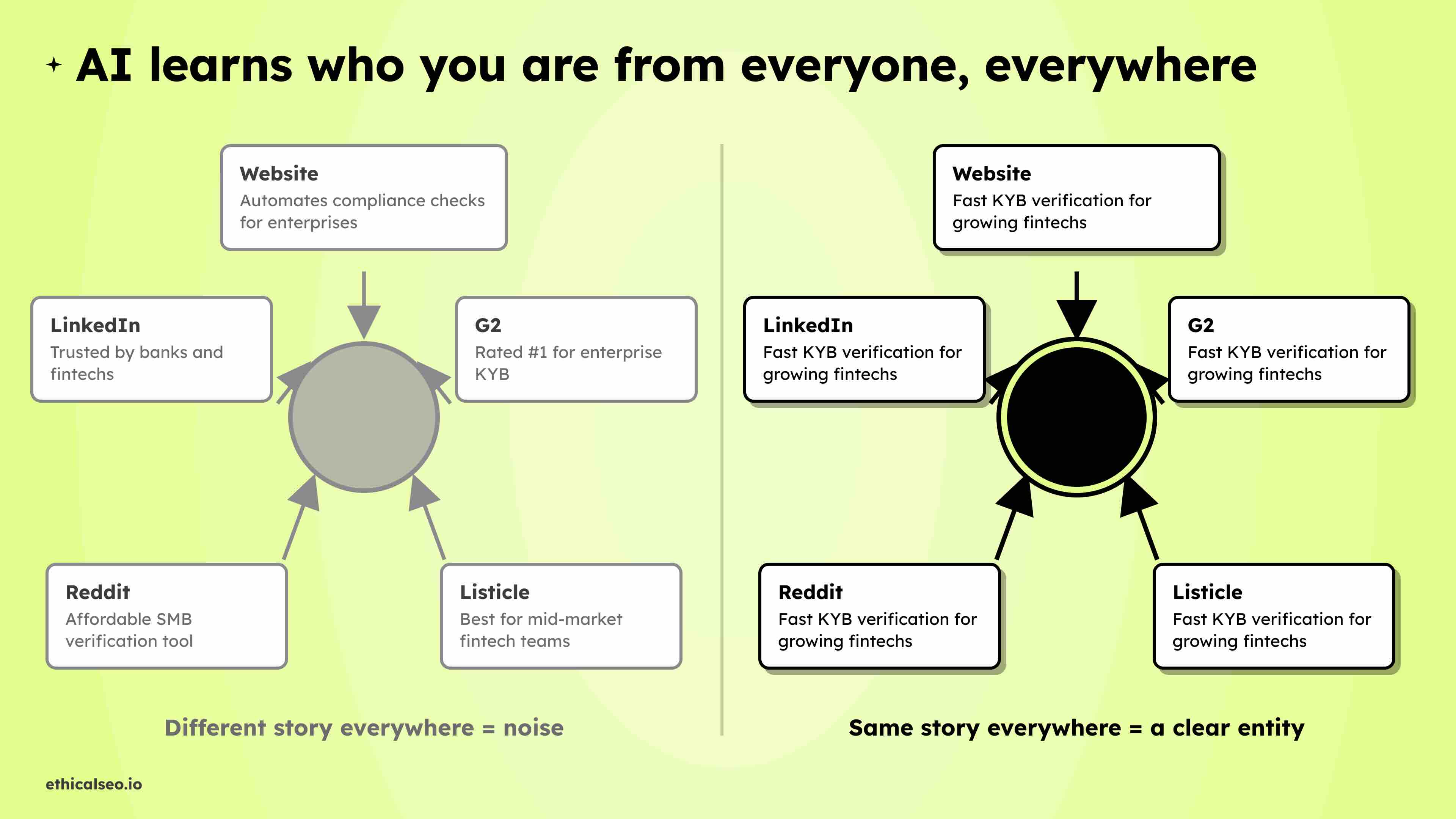
Here’s proof this works in practice:
For Vespia, a compliance and KYB verification SaaS, we crafted one unified description of what the company does and used it across every placement, listicle, and PR mention. Combined with foundational SEO, that consistency produced 597 LLM sessions, 49 demo-click conversions from LLM traffic, and a 10x rise in qualified leads. Mastercard found them through an AML software listicle — and Vespia was acquired by Veriff, the KYC unicorn, in February 2026.
You can read the full case study here.
The second step of the diagnostic is to understand your ICP better than your competitors do.
Keyword research tells you what people type into Google. Prompt research tells you what they ask an AI, and that is not the same text.
Nobody types "KYB software vendor comparison EU" into ChatGPT. They ask, "We're onboarding business customers in Germany, what tools will verify them fastest?"
To solve this, choose an underused method like interviewing your customers. Find out how they look for information, then group what you learn by persona, because a compliance officer and a founder ask about the same product in completely different words. The output is a prompt library with the actual questions each profile asks, in their phrasing, organized by intent.
Then there's the layer you can't see. When someone asks an AI about "best running shoes," the engine doesn't just process that one query. It silently generates follow-up questions (grip, durability, price, use case) and looks for sources that cover them. This is called query fan-out, and Ahrefs has a good breakdown of how it works.
Fan-out is probably a bigger deal than most people realize. Ahrefs tracked how often Google's AI Overviews cite pages straight from the original top 10 results, and the overlap dropped from roughly 76% in July 2025 to about 38%.
What we deciphered is that the answers are increasingly assembled from fan-out queries you never see in any keyword tool. Your prompt library should map those clusters, along with the main question.

Now, and only now, do we look at content. And we start with what you already have, because it is always easier to improve your existing content.
The audit runs in this order:
Information gain is the extra unique information you put on the table, ranging from original research and proprietary frameworks to real client data and an angle nobody else covered. Content without facts is generic content, and AI won't reference it.
One counterintuitive finding should shape the whole audit. Kevin Indig and AirOps pushed 16,851 queries through ChatGPT's retrieval pipeline and found that pages covering 26-50% of subtopics outperformed pages covering 100% of them, as long as the match to the main query was strong. The first retrieved result got cited 58.4% of the time, and position 10 got 14.2%.
What does that mean? The 6,000-word ultimate guide is no longer a moat. One focused page that nails one question beats five adequate pages, and it definitely beats one bloated page that nails nothing.
The improve-first discipline pays. For an SMS gateway provider, we updated 28 underperforming articles instead of replacing them. Those pages doubled their average monthly visits within a campaign that raised lead acquisition by 246.88%.
Now that the diagnostics are done, let us move on to the execution part of how to write, where to show up, and what to do when the AI gets you wrong.
Forget skimmable content. Skimmable is for humans in a hurry. The goal here is to build a structure that AI models can extract cleanly.
AI is lazy, but it loves structure. It prefers pre-synthesized formats such as tables, lists, and clearly bounded sections. Instead of writing three paragraphs comparing prices, build the table. If you give the AI a table, it lifts the table. And when it lifts the table, it cites you.
The opposite is just as mechanical. Write one giant paragraph that mixes pricing, features, and support, and the math works against the page: the model averages all those words into one blurry vector that matches no specific question well. One clean topic per section, and every section a self-contained 80-150 word answer.
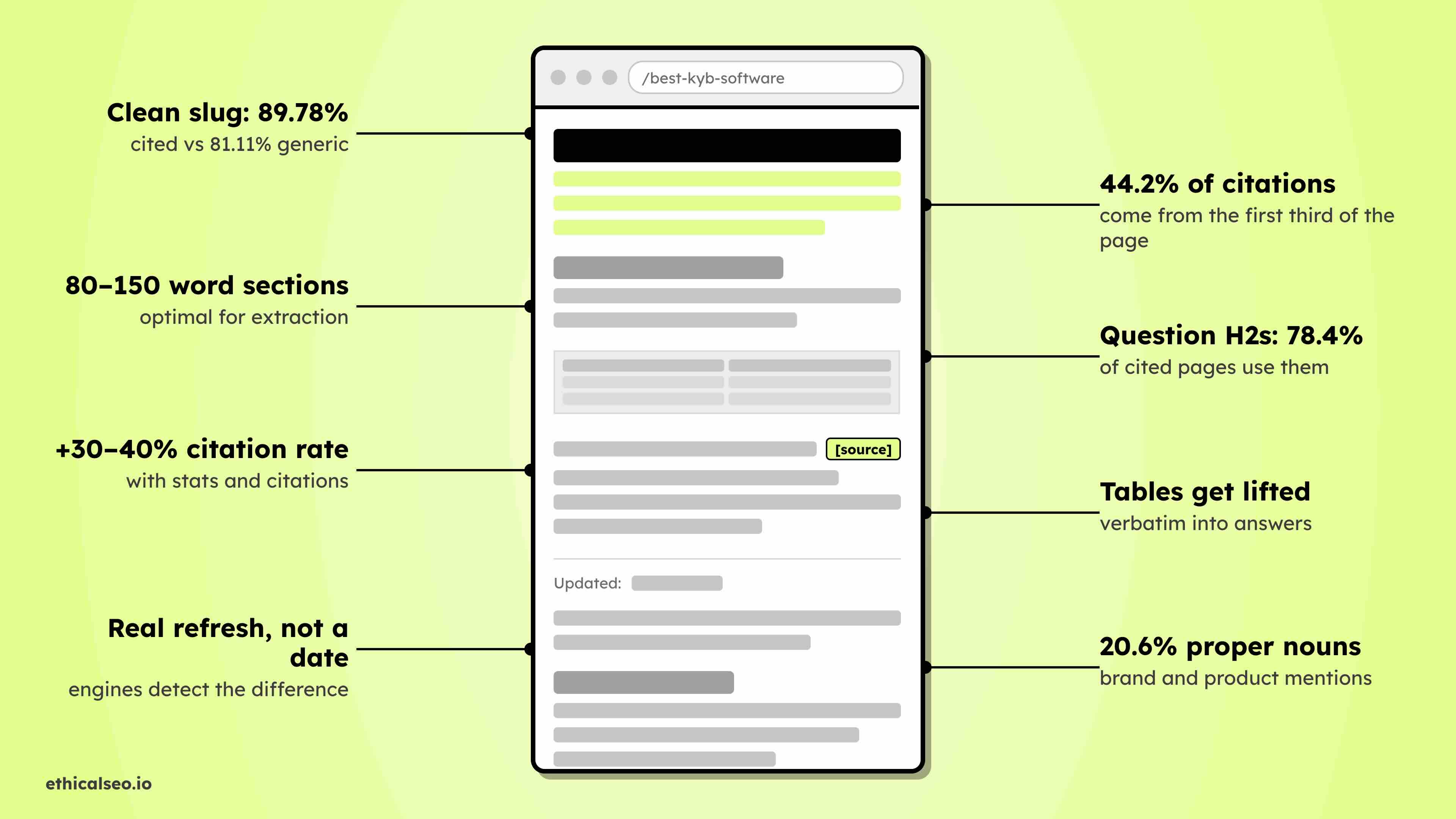
Here are eight straightforward rules to follow while building your content:
44.2% of ChatGPT citations come from the first 30% of a page. So, as opposed to warming up or building a narrative, answer the question in the first two or three sentences, then expand.
AI-cited content is 25.7% fresher than what ranks organically (Ahrefs, 17 million citations analyzed), and 89.7% of ChatGPT's most-cited pages were updated in 2025. Add new data and fix old facts. Changing the date and nothing else has stopped working long ago.
Run every page through these eight rules before you hit publish. For a deeper technical breakdown, see our guide to optimizing content for LLMs.
Everything mentioned until now happens on your own site. That's the easier part of the work. However, you know that the model learns who you are mostly from everyone else.
How do you tackle that?
If we could only pick one tactic to get started, we’d strongly recommend listicle guest posts.
We got a client to appear in ChatGPT answers with a standard guest post.
A "top 7 tools for X" listicle placed on a mid-tier tech blog. That article got scraped into training data, and the AI learned the brand from it. This is not a one-off, and most often, listicles get scraped because they're structured and they answer comparison questions directly. That’s why AI uses them to decide which brands belong in a category.
The old reason for a guest post was the backlink. The new reason is training the model.
Same tactic, double the return.
One caveat before you scale this is to get your positioning right first. Placements work by repeating a clear story about who you are. If the web tells a muddled story about your brand, more listicles and backlinks may still help you rank in Google, but the AI won't recommend you for a category it isn't sure you belong to.
And at campaign scale, it compounds. For one of our clients, we delivered 56 listicle insertions, 19 guest posts, and 21 link insertions over 12 months, helping them reach #8 in Google for "video editor". It also helped them gain LLM visibility from appearing in training data.
Beyond listicles, go where the models actually look.
AI search engines cite Reddit, YouTube, and LinkedIn more than any other domains, and Semrush's three-month citation study shows the same concentration. So be genuinely active there and answer questions on Reddit, publish useful videos, and post regularly on LinkedIn.
Quality matters more than volume.
One Ahrefs study showed that models learn brands from mentions across the web. Our working assumption, though no study has tested it directly, is that the same logic cuts both ways. Mentions on low-quality sites teach the AI a weak or wrong picture of your brand.
Put simply, off-page work is now also AI training. So, get the same clear description of your brand into the places models learn from. That is exactly what our off-page SEO services are built around.
Now, a question that gets less attention than it deserves is what happens when the AI talks about you and gets it wrong?
It will. 61.6% of our survey respondents have already hit misinformation or bias in AI answers, and 55.4% name hallucinations as their top concern.
When the wrong answer is about someone else's brand, it's a curiosity. When it's about yours (wrong pricing, a feature you killed two years ago, a competitor listed as your parent company), it's a sales problem you can't see.
Why does it happen? Two mechanisms, but both are fixable.
First, sparse or conflicting entity information. If the web disagrees about who you are, the model fills in the gaps with probability. That's a hallucination with your name on it.
Second, and more common, are outdated sources. A 2022 review describing your old pricing can outweigh your current site if it's the strongest passage available for that question. The model isn't lying as it's citing something that was once true but is no longer.
The fix loop goes like this:
Freshness is your ally here.
Remember, AI systems prefer content that's 25.7% fresher than organic results. The machine wants to cite the new, correct version of you. Give it one.
Every new channel breeds shortcuts. Here's what doesn't work when it comes to AI SEO.
Thin fan-out pages
Spinning every sub-question into its own page is massive content abuse. Go deep on one page instead.
Schema as an AI trick
Ahrefs tracked 1,885 pages that added JSON-LD schema and found no significant citation increase on any AI platform and the retrieval systems extracted visible HTML only.
Use schema for normal SEO reasons, and treat it as standard SEO hygiene rather than an AI visibility lever. While we're here, schema and keyword stuffing are not the same thing, and keyword stuffing fails on its own merits, as it showed little to no lift in the KDD 2024 GEO study.
AI-written filler
ChatGPT runs a live web search for only 34.5% of queries. Most answers lean on training data, where generic machine-spun text has no gravity at all. It's also the exact thing 61.6% of users say they already distrust.
Mentions on weak sites.
Volume without trust is unlikely to teach the model anything useful.
One last point, and this one is our best guess rather than a proven fact. We suspect AI systems read only part of most pages.
Why? Cost.
It is far more expensive for an AI to process a full page than for Google to look something up in its index. No study has confirmed this yet, but it would explain why answering early and structuring cleanly matter so much.
You know what to build and where. What's left is proving it works. Here’s all you need to know about the numbers worth tracking, where to begin based on your goals, and what to look for if you bring in outside help.
Your CEO will ask one question. Is it working? Here's how to answer it with numbers that survive scrutiny.
Set up before you start.
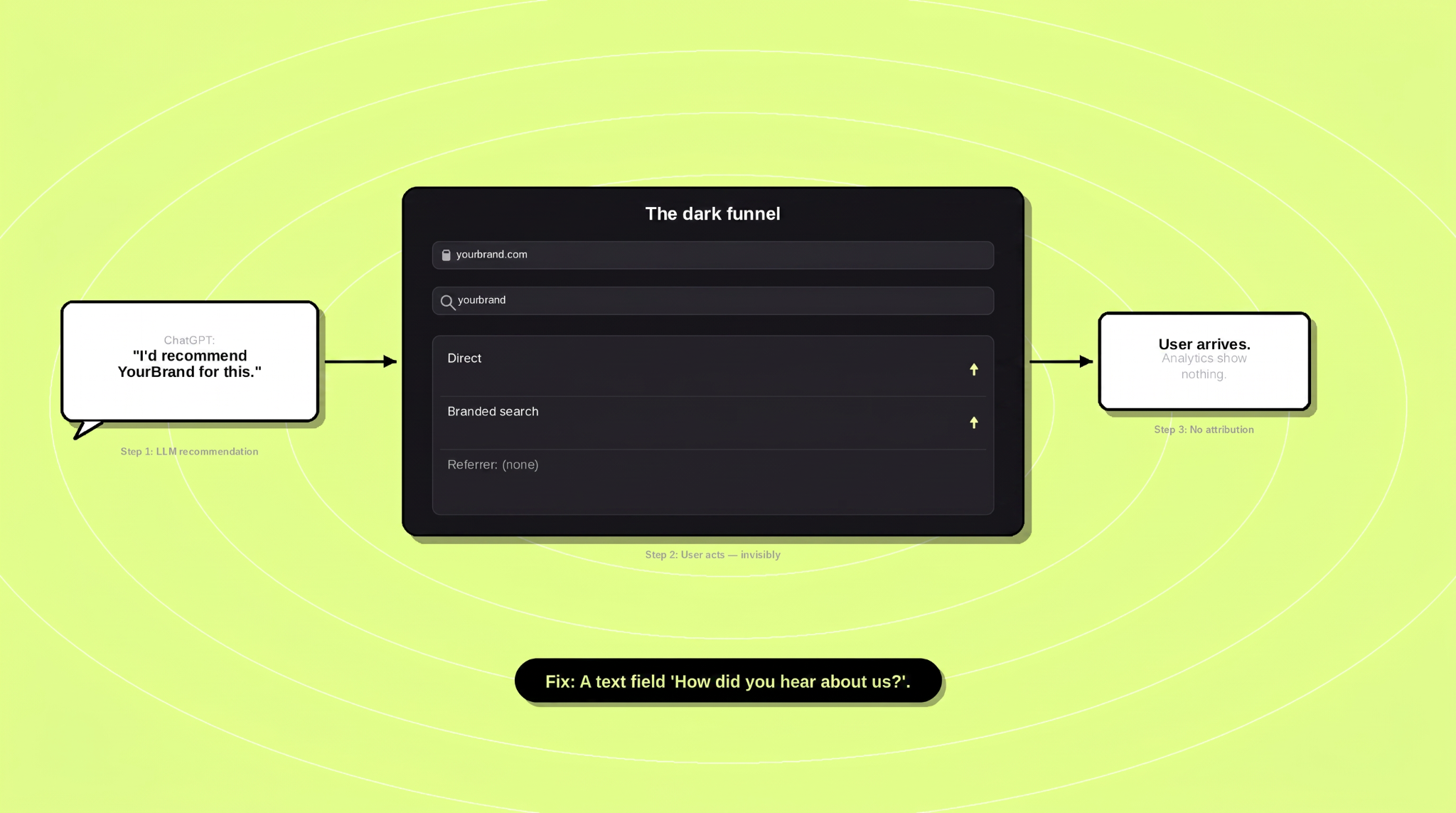
A free-text field forces self-attribution, and it's the only reliable light you'll get into what we're about to describe.
Understand the dark funnel.
When someone finds you through an LLM, they typically don't click anything. They type your domain straight into the browser, or they Google your brand name because they can't remember if you're .com or .io. Your analytics logs "direct" and "branded search."
The LLM's influence is invisible. That's why it's called dark. Watch branded search volume and direct traffic as trailing indicators, and when they climb alongside your AI visibility work, that's the funnel showing itself.
Measure appearance frequency. You already know that the same prompt, different answer, under a 1% repeatability process.
So run each buyer prompt 50-100 times, track how often your brand appears, and compare against competitors. Appearing in 70 of 100 answers is strong visibility. 3 of 100 is invisible. This is the method SparkToro's research points to, and it's the difference between a real signal and a screenshot.
The numbers that map to business are
The numbers that mislead are raw mention counts on weak sites, impressions with no referral behind them, Domain Rating for its own sake, and any tool reporting your AI ranking from a single run.
Although they feel like progress. They rarely are.
The AI SEO market is young, and experience levels across providers vary widely, which is normal for any new discipline. It does mean the evaluation criteria are worth spelling out before you sign anything.
The most important filter is that the work must not come at the cost of your foundational SEO.
Remember, Google still drives roughly 95% of your traffic, and AI visibility gains mean little if your rankings decay while you pursue them.
Ask foundational questions first:
Their answers there tell you more than anything they say about AI.
Then apply three checks:
If you're evaluating options, our roundup of the best GEO agencies is a starting point, including notes on who we're not the right fit for.
Nothing in this guide is exotic, and that's the point.
Wallester did not get its 796% LLM referral growth from a hack. It came from positioning consistency, quality placements, and content built for extraction, run as one system for a year.
Younium demos from ChatGPT came from listicle placements, and KYB Company's Mastercard lead also came from a listicle, backed by a single brand description repeated everywhere it mattered.
The pattern holds in the other direction.
When AI visibility work fails, the autopsy usually finds a fuzzy entity nobody agreed on, thin pages spun out to chase fan-out queries, or foundational SEO set aside while the new channel got all the attention.
So, in a nutshell, keep the SEO that pays your pipeline, fix your positioning before your content, write pages a lazy AI model can lift, get into the listicles and communities it learns from, and measure appearance frequency across many runs.
Your buyers are already asking. The only question is whose name is in the answer. Want to know where you stand today? Book a strategy call, and we'll map it out with you.


