


Key Takeaways
Search has flipped on its head, and an embarrassing number of SaaS and B2B teams didn’t see it coming.
For over two decades, companies poured resources into Google rankings to drive leads. Now, AI platforms like ChatGPT, Perplexity, and Google AI Overviews (AIO) increasingly deliver direct answers, often pulling from only a handful of sources. Users can get what they need without clicking through traditional search engine results pages (SERPs).
The scale of this shift is significant.
Gartner predicts that traditional search engine volume could decline by 25% by 2026 as more users turn to AI chatbots and virtual assistants for information. McKinsey’s predictions state that by 2028, AI-powered searches may drive $750 billion in revenue in the US.
For brands, this trend creates a new challenge: invisibility. If AI skips your content, potential customers may never find you, even if you rank highly in traditional search results.

This crisis has led to the rise of Generative Engine Optimization (GEO).
GEO focuses on boosting entity recognition, authority signals, and citation-worthiness so brands are more likely to be referenced by AI systems when they generate answers.
If you want a deeper explanation of how GEO works and how your company can implement it, check out our full guide to Generative Engine Optimization
As AI search becomes more influential in how people research products, vendors, and solutions, many companies are realizing that traditional SEO strategies alone won’t cut it. That’s why you might want to start looking into specialized GEO agencies.
In this guide, we break down the 8 best GEO agencies of 2026. to consider in 2026. You’ll also find a framework for evaluating your options, potential red flags to avoid, and signs it may be time to hire outside help.
Whether you’re a CMO watching traffic stall or an SEO manager preparing for AI-driven discovery, this guide can help you choose a partner that keeps your brand visible.
Generative Engine Optimization delivers results for enterprise SaaS and B2B marketers facing AI invisibility, but it’s not universal.
Consider working with an agency when traditional traffic stalls or dips, AI search dominates your buyer research, or internal teams lack large language model (LLM) expertise.
But if you’re a local business, chasing quick black-hat fixes for overnight rankings, or not ready for 6 to 12 month investments, you might want to sit this one out.
This guide targets high-intent decision-makers who are ready to act.
We evaluated these 8 best GEO agencies based on their grasp of AI search mechanics, SaaS experience, publicly available client feedback and ratings, and strategies for boosting AI citations. Each brings different strengths to help B2B brands stay visible as generative search takes over.
Here’s the breakdown.
Best for: SaaS companies that want to build authority for both traditional search and AI responses
Ethical SEO focuses on software businesses with ethical link building, digital PR, and authority strategies that play directly into how AI search works.

They handle manual outreach to land placements in niche publications and high-trust sites, creating the citation networks that ChatGPT, Perplexity, and Google AI Overviews often prioritize for responses. This isn’t random; it’s targeted work that boosts entity recognition and topical depth, so your brand shows up more often in generative answers.
They stand out with SaaS-specific tactics. Following events such as funding rounds or product launches, clients get campaigns blending PR placements, content clusters, and schema tweaks to strengthen knowledge graph presence.
Their AI readiness audits scan for LLM visibility gaps, like weak entity salience or missing authoritative mentions. One campaign might secure 10+ editorial backlinks from DR 70+ domains, all paid only after they’re live. That’s real risk reduction for enterprise teams.
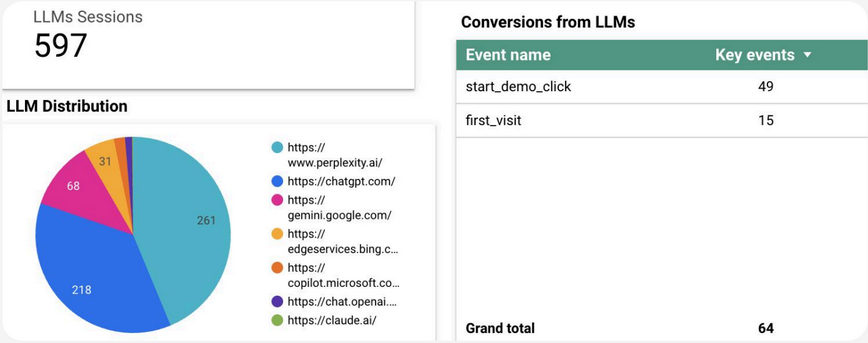
By combining technical SEO with LLM-aware digital PR placements specifically targeting AI training data sources, Ethical SEO helped one SaaS client increase qualified leads by 10x for a KYB client.
Ready to audit your AI citations? Book a GEO strategy call.
Best for: B2B teams leaning on thought leadership to land qualified leads in complex industries
First Page Sage starts with buyer research, mapping the exact questions prospects ask during evaluation. They turn the findings into cornerstone content, such as deep guides, benchmarks, and analyses, that positions clients as the go-to voice in their niche.
For SaaS and tech firms, this means topic clusters covering full buyer journeys, from awareness to decision, built to earn natural backlinks and steady traffic.
Their campaigns typically run 6 to 12 months, blending on-page tweaks, content production, and performance audits. Clients get monthly breakdowns showing share of voice gains and how content drives form fills or demos. It’s hands-off for internal teams who lack time for custom research.
Their focus on complex B2B sales cycles sets them apart, especially in industries where buyers repeatedly reference materials like fintech comparisons or martech breakdowns.
$10,000+ per project (Clutch data)
Best for: Brands scaling content marketing with data studies and visual assets
Siege Media combines editorial-quality content with outreach to drive backlinks and traffic. They specialize in research-backed pieces like industry benchmarks, surveys, and interactive tools that journalists and publications frequently reference.
Their SaaS clients often see campaigns kick off with competitive analysis, then move to creating linkbait assets like infographics, calculators, and such, which perform across search and social.
Typical projects span 3 to 6 months, including content creation, designer polish, and targeted pitching to niche pubs. Clients report strong ROI through traffic growth and referral volume, with dashboards tracking impressions and clicks. Their in-house creative team handles visuals, which helps assets spread faster than plain text.
Clutch: 4.9/5
Starting from $5,000 per project, with larger campaigns ranging from $50,000 to $200,000 (Clutch data)
Best for: Businesses adapting marketing strategies specifically for AI-driven search environments
Genevate focuses on generative engine optimization campaigns designed specifically for AI search engines like ChatGPT and Perplexity.
Founded by marketing expert Brett Kleinberg, they help clients shape how their brands appear in generative responses through digital PR, reputation management, and authority building.
Rather than adapting traditional SEO playbooks, their approach combines AI narrative positioning with media placements to turn brands into recognizable entities in LLM outputs. Projects typically emphasize long-term visibility over quick rankings, with public relations expertise handling both growth and risk scenarios.
Public reviews unavailable on major B2B platforms
Custom pricing (retainer-based, contact required)
Best for: Companies needing technical SEO alongside digital PR and reputation management
Go Fish Digital offers full-service digital marketing, leaning heavily on technical SEO, paid media, content, and PR. Active since 2005, the agency has been working with companies ranging from startups to large enterprises across industries.

For SaaS teams, their core offering involves addressing technical performance factors such as Core Web Vitals (CWV), schema implementation, and site speed, while layering on PR campaigns that land coverage in tech outlets.
Their reputation management arm monitors brand mentions and counters negative signals, which matters as AI pulls from a broader web context.
Clutch: 5.0/5
Starting from $5,000 per project, with larger campaigns ranging from $10,000 to $50,000 (Clutch data)
Best for: B2B and SaaS companies wanting revenue-focused marketing
Directive Consulting lives by their “Customer Generation” methodology, connecting every marketing dollar to measurable outcomes like sales-qualified leads and closed deals. They work almost exclusively with tech and SaaS, building strategies around account-based marketing (ABM), paid search, and organic channels.
SaaS clients get integrated programs: SEO content clusters targeting high-intent keywords, ads targeting decision-makers, and creative landing pages built for conversion.
Directive reports more than $1 billion in attributed client revenue across its portfolio.
Clutch: 4.8/5
Best for: SaaS companies seeking search-driven growth through content and technical optimization
Scalerrs caters to subscription businesses, offering SEO management, content creation, and strategic link building. They focus on long-term organic visibility rather than traffic spikes, helping SaaS teams scale recurring revenue through consistent content engines.
Campaigns typically kick off with technical audits covering site performance, mobile UX, and crawl errors. From there, the team develops content targeting buyer intent across multiple stages of the funnel.
Programs often run for 6 months or more, spanning keyword expansion, content briefs optimized for conversion, and outreach for contextual backlinks from industry publications and blogs.
SaaS founders like their hands-on approach, with weekly calls, clear roadmaps, and dashboards showing traffic quality alongside rankings.
Clutch: 5.0/5
Starting from $5,000 per project, with larger campaigns ranging from $10,000 to $50,000 (Clutch data)
Best for: B2B SaaS companies building scalable content systems for long-term organic growth
Minuttia helps software businesses create structured content engines that align with search intent and customer journeys. Founded in 2020, they focus on building repeatable content systems rather than isolated campaigns.

SaaS clients get data-backed strategies, typically starting with competitive gap analysis, followed by topic planning, editorial calendars, and SEO-optimized publishing frameworks, covering pillar pages, clusters, and supporting assets that drive qualified traffic. The goal is consistent publishing that builds topical authority over time while aligning content performance with revenue metrics.
Clients have appreciated their focus on scalable processes: once systems are in place, internal writers can maintain momentum without constant agency input.
Picking a GEO agency isn’t like hiring for traditional SEO.
AI search systems like ChatGPT, Perplexity, Google AI Overviews don’t just rank pages. They parse meaning from multiple sources, synthesize answers, and cite what’s authoritative and contextually relevant.
The right partner gets this and proves it with results and not just buzzwords.

Start by digging into their actual capabilities. Ask for case studies showing brands appearing in AI responses, not just lucky traffic bumps. Look for teams that track citation frequency across platforms and tie it to leads.
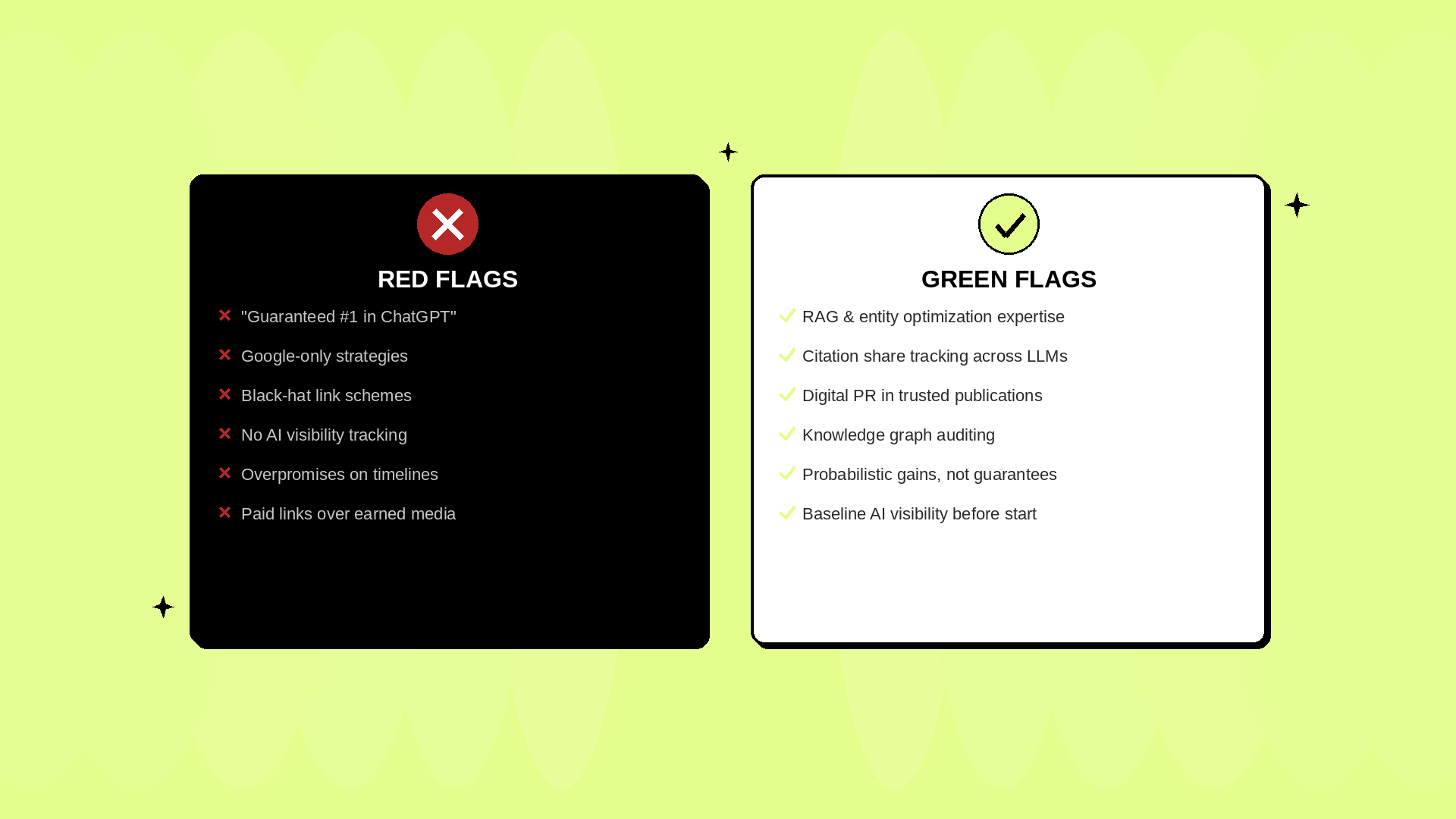
Skip anyone promising “guaranteed #1 in ChatGPT”. Generative responses vary depending on queries, model updates, and the sources available at the time.
Focus on the following core factors when vetting your options.
Strong agencies grasp how LLMs work under the hood. They know these systems often use semantic analysis and vector embeddings, not just keywords, to spotlight sources.
Look for teams that can explain concepts such as retrieval-augmented generation (RAG), entity extraction, and how authoritative sources influence AI responses, instead of larping on about generic SEO talk.
AI loves clear entities – which, in this case, would be your brand as a distinct, authoritative node – and the relationships between them.
Even beauty giant L’Oréal, which obviously dominates Google rankings, has lost ChatGPT product recommendations to Fenty and Estée Lauder because LLMs prioritize entity clarity (product formulation, pricing signals) over traditional authority.
As detailed in iPullRank’s L’Oréal case study, L’Oréal’s knowledge graph lacked key attributes that competitors had, proving even market leaders need LLM-specific entity work.
Agencies should have a focus on strengthening structured data (schema markup), ensuring consistent brand info across directories, and creating Wikipedia-caliber brand pages. Check if they audit your knowledge graph presence via tools like Google’s Knowledge Graph Search API. Strong players build co-citation networks, i.e., mentions alongside competitors on trusted sites.
Great content screams, “This is about [your brand] solving [specific problem].” Agencies should boost entity salience with clear headlines, internal linking, and statistics positioned prominently. They should want to build topical maps covering your niche end-to-end, so LLMs see you as the expert.
Look for portfolios with content clusters that dominate query spaces, earning citations in AI summaries for related questions.
Generative engines frequently favor high-trust domains. Look for agencies that earn this through digital PR in top publications like Forbes, TechCrunch, or other industry journals, not low-quality directories.
Evaluate their placement quality. Ask agencies about their hit rate on guest posts versus placements. True authority builders prioritize earned media over paid links and automated link schemes.

Forget rankings for a bit. GEO metrics include citation share (how often you are mentioned vs. competitors), position in AI responses, and impression share across platforms.
A credible GEO agency should be able to explain how it tracks these signals and how improvements in AI visibility translate into real business outcomes.
They should demo custom trackers for ChatGPT, Perplexity, and AIO, plus sentiment analysis on citations. True ways for GEO performance tracking are still largely in the developing stage, but these should be a good place to start.
You should also demand baselines like “Show me our current AI visibility before we start.”
No ethical agency can guarantee specific AI placements. Outputs depend on query wording and context, model updates, and real-time data. Watch for overpromises on timelines or rankings, because those scream black-hat thinking.
Choose partners focused on probabilistic gains through authority rather than manipulation.
AI search is shifting fast. If your brand rarely appears in answers from platforms like ChatGPT, Perplexity, or Google AI Overviews, it may be time for an audit.
In a 30-minute strategy call, our team will review:
Book a strategy call with Ethical SEO to get a live review of your current AI search visibility and a personalized roadmap that we can help you start with right away.
Traditional SEO focuses on ranking webpages in search results.
GEO focuses on improving the chances of a brand’s content and authority signals being recognized by AI systems that generate answers to user questions.
This often involves entity optimization, digital PR, and authority-building across trusted websites, rather than optimizing just for keyword rankings.
Yes, although the lines are beginning to blur.
Traditional SEO agencies focus primarily on helping websites rank higher in search engine results through keyword optimization, technical SEO, and backlinks.
GEO agencies focus on improving a brand’s visibility in AI-generated answers from platforms like ChatGPT, Perplexity, and Google AI Overviews.
In practice, most companies benefit from combining both SEO and GEO to stay visible across traditional search engines and AI-driven discovery platforms.
Test 5 to 10 high-intent queries in ChatGPT, Perplexity, and Google AI Overviews. Try queries like “best [your category] software,” “top [competitor] alternatives,” and “[problem] solutions 2026.” If your brand rarely appears across multiple queries, it means you may need a more comprehensive audit and a plan of action. A GEO audit can help benchmark your current visibility and identify gaps.
The most common GEO metrics include citation share, AI visibility, referral traffic, and entity signals.
Because AI search measurement is still evolving, agencies may combine multiple indicators to estimate visibility trends.
Several issues can weaken visibility in AI-generated answers, such as:
Improving these signals can strengthen the overall credibility of a brand’s web presence.
Yes. Each platform evaluates sources somewhat differently:
Agencies must test all 3 platforms weekly and adapt.
There are no guaranteed shortcuts here, because LLM behaviors are not predictable. Brands sometimes begin appearing in AI-generated citations after new authoritative mentions are indexed, but timelines vary widely. There are certain phases you can expect:
Agency if:
Internal if:
Hybrid approach:
Companies should consider hiring a GEO agency when:
Organizations that invest early in GEO strategies are more likely to maintain visibility as AI search becomes more widely used.
Key factors include:
These capabilities help companies strengthen the signals AI systems rely on when selecting sources for generated answers.
Pricing varies depending on campaign scope, authority-building efforts, and the competitiveness of a company’s industry.
Many GEO agencies offer monthly retainers ranging from a few thousand dollars to enterprise programs exceeding $20,000 per month. Some agencies also offer performance-based pricing for digital PR placements or authority-building campaigns.
You should evaluate pricing alongside an agency’s experience with businesses similar to yours, and its ability to build credible authority signals across trusted sources.


