If you're running a SaaS-focused SEO program, you don't want a collection of tactics; you want a repeatable framework.
The 5-phase SaaS SEO strategy framework below is built for companies with B2B sales cycles longer than 14 days, paid-search-heavy backgrounds, and a need to prove pipeline from organic over time. Each phase builds on the preceding one.
If you're a CMO, this framework should feel like a playbook you can hand to your SEO team or an agency and say, "This is how we structure SEO for the next 12 months."
If you're the SEO Manager, it should feel like a working document that clarifies priorities, beyond being a mere to-do list.
Now let's walk through each phase in detail.
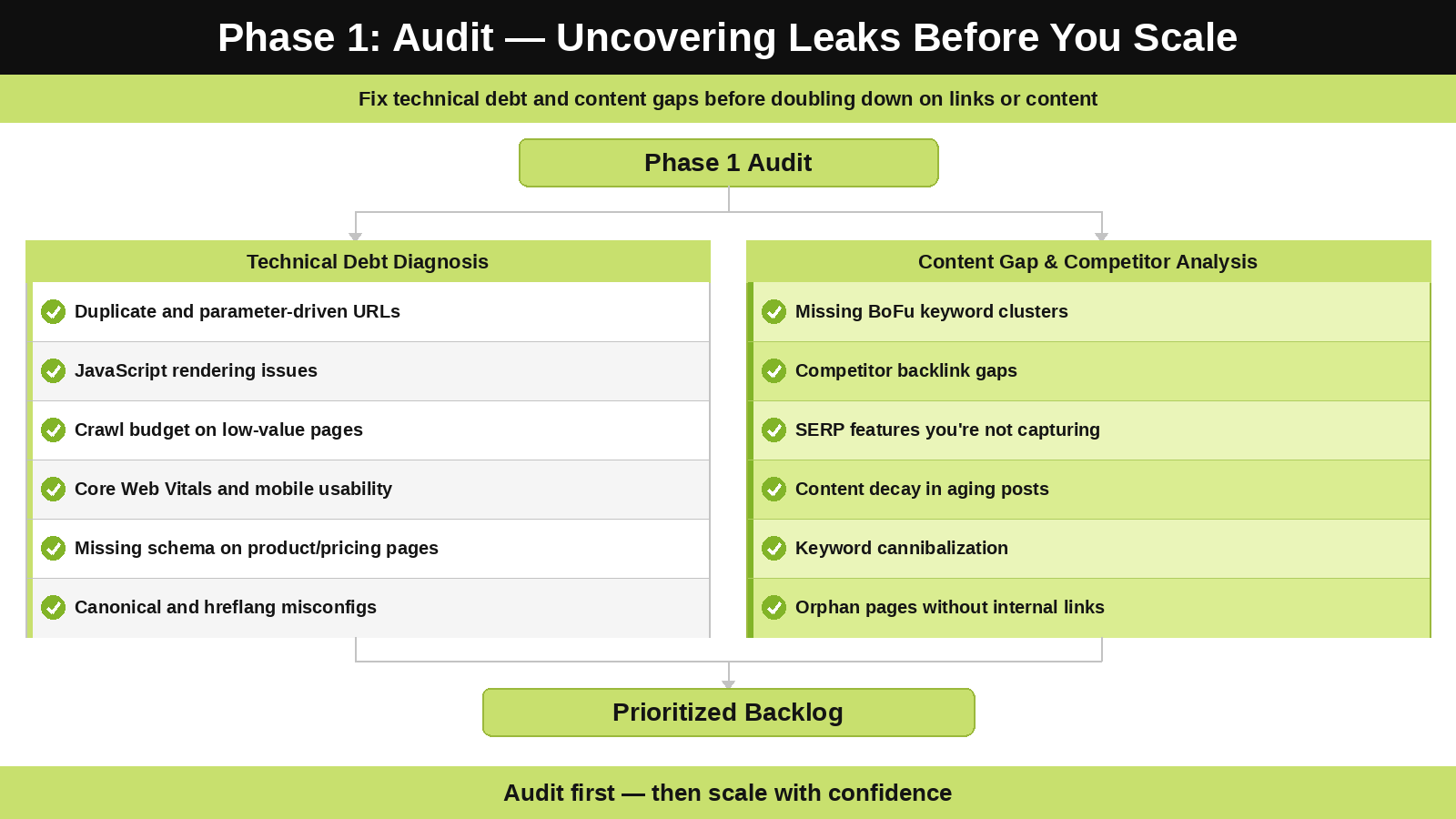
Before you double down on content or links, you need to know what's leaking today. A SaaS-specific audit is a systematic look at technical debt, content gaps, and how your structure lines up with your funnel.
The goal of Phase 1 is to identify where crawl budget and ranking signals are being wasted, surface content gaps that are letting competitors own important keyword clusters, and find structural issues that prevent high-intent pages from ranking despite strong content.
Technical debt is one of the biggest hidden blockers in SaaS SEO, especially in apps with dynamic URLs and heavy JavaScript.
Key areas to audit include:
A clean technical foundation doesn't guarantee rankings, but without one, even strong content and links will underperform.
After you've fixed the biggest technical leaks, the next step is to see where your content is missing, overlapping, or decayed. This is where you move from "What do we have?" to "What should we have?"
This typically includes:
The goal is to build a prioritized backlog: which clusters to create, which pages to consolidate, and where competitors are currently winning.
This step is about building a structure that can handle growth. For SaaS, that means two big pieces: a funnel-mapped keyword architecture and a crawl-budget-friendly indexation strategy.
You're not just building a website structure. You're building a pipeline-driven content architecture that can survive SERP and AI-search shifts over time.
A SaaS keyword strategy should map directly to the buying journey instead of religiously prioritizing search volume.
Core components include:
This structure ensures every keyword contributes to both pipeline and traffic — ideally.
For SaaS, crawl budget is a limited resource. You can't throw all of it into dynamically-generated dashboards and filters. You need to prioritize revenue-driving pages.
Here are some practical steps you can take.
This kind of indexation and crawl-budget work is often the single biggest lever for SaaS SEO ROI, especially when your app generates a lot of dynamic URLs.
Once your technical foundation and keyword architecture are in place, content becomes the layer that translates visibility into pipeline.
But in SaaS SEO, content should be about converting intent into pipeline instead of bulk-publishing editorial pages.
You need to enable product surfaces to drive the highest conversions. Instead of asking what to publish, ask: "Which pages can capture high-intent traffic and convert immediately?"
Content still supports the system, but its role is to reinforce and feed authority into revenue-driving pages.
In most SaaS environments, the highest-converting organic pages are not blog posts; they’re product-adjacent pages aligned with specific use cases or workflows.
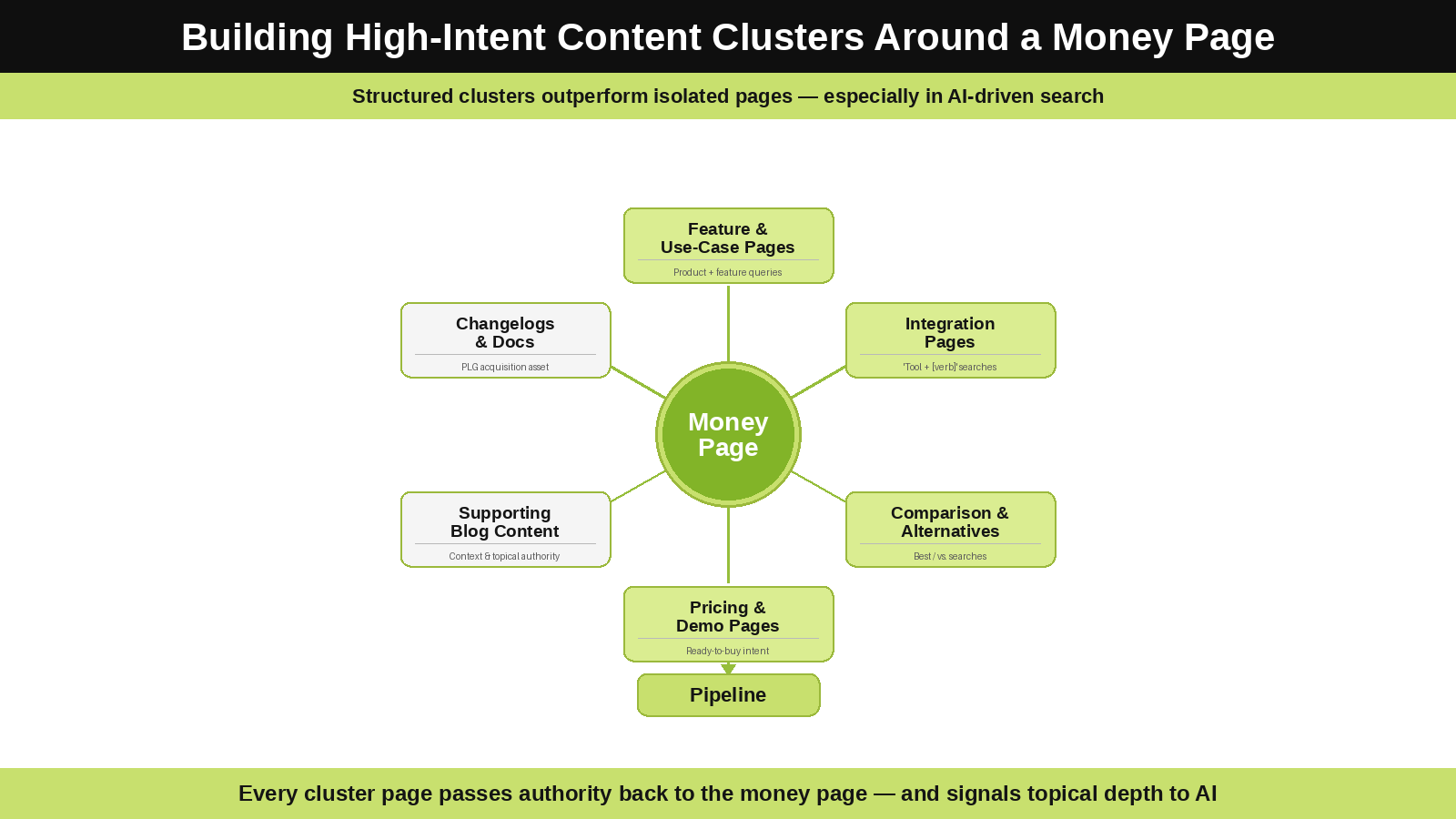
This includes feature and use-case pages targeting problem-aware queries, integration pages capturing "tool + tool" searches, comparison and alternative pages for BoFu intent, and pricing and demo pages optimized for "ready-to-try" traffic.
These pages sit closest to revenue. When structured correctly, they can rank and convert in a single step. Editorial content still plays a role, but primarily as a support layer that builds context and feeds authority into these high-intent pages.
Content only compounds when it's structured.
Instead of publishing standalone articles, build clusters around revenue-driving themes: a core "money page" (feature, use case, or product page), supporting content that targets adjacent queries, and internal links that consolidate authority into the core page.
Over time, this creates a structural advantage. Competitors may outrank you with individual pages, but they will struggle to compete with a fully developed cluster.
This is particularly important in AI-driven search, where structured, interlinked content is easier for AI systems to interpret, extract, and cite.
Even when content ranks, pipeline often leaks at the conversion layer.
Common issues include a mismatch between query intent and landing page, weak or generic CTAs on high-intent pages, friction in trial or demo flows, and no capture mechanism for early-stage visitors.
Fixing this doesn’t require more content. It requires better alignment.
Because ultimately, content doesn't drive pipeline on its own. It needs a support system.
Phase 4 focuses on scaling authority in a way that compounds over time. This is where link-building, brand mentions, and AI-focused authority signals come into play.
Backlinks still convey authority, but the way most agencies talk about "links" is out of touch with SaaS realities.
Ethical, SaaS-focused link-building focuses on:
The goal should be acquiring high-quality, SaaS-focused links that support your pipeline-driven pages.
Backlinks are only one layer of authority. In 2026, visibility, especially in AI searches, also comes from how consistently your brand is mentioned, structured, and recognized across the web.
Here are some effective strategies:
Together, these signals create a broader "authority surface" that search engines and LLMs can use beyond traditional backlinks.
Visibility in AI-driven search depends on structured, easily extractable content, clear authority and trust signals, and consistent presence across third-party sources such as Reddit communities and Wikipedia-style pages.
This is where AI SEO, particularly Answer Engine Optimization (AEO), comes in. It involves structuring content so it becomes more likely to appear in AI responses generated by ChatGPT, Gemini, and the likes, on top of ranking higher in traditional SERPs.
A great example of AI visibility success comes from one of Ethical SEO's KYB-focused SaaS clients, who we helped 10x their inbound leads by combining AI-search optimization, product-led SEO, CRO, and digital-PR-style link building.
In this last phase, you close the loop and prove that SaaS SEO is a real growth lever. You're moving from "We rank for X keywords" to "We drove Y MQLs and Z pipeline from organic last year."
A SaaS-focused SEO program needs a forecasting model that connects every major lever to pipeline. A typical chain looks like this:
Links → Rankings → Traffic → Sign-ups → MQLs → SQLs → Closed-won
You can also add further depth with:
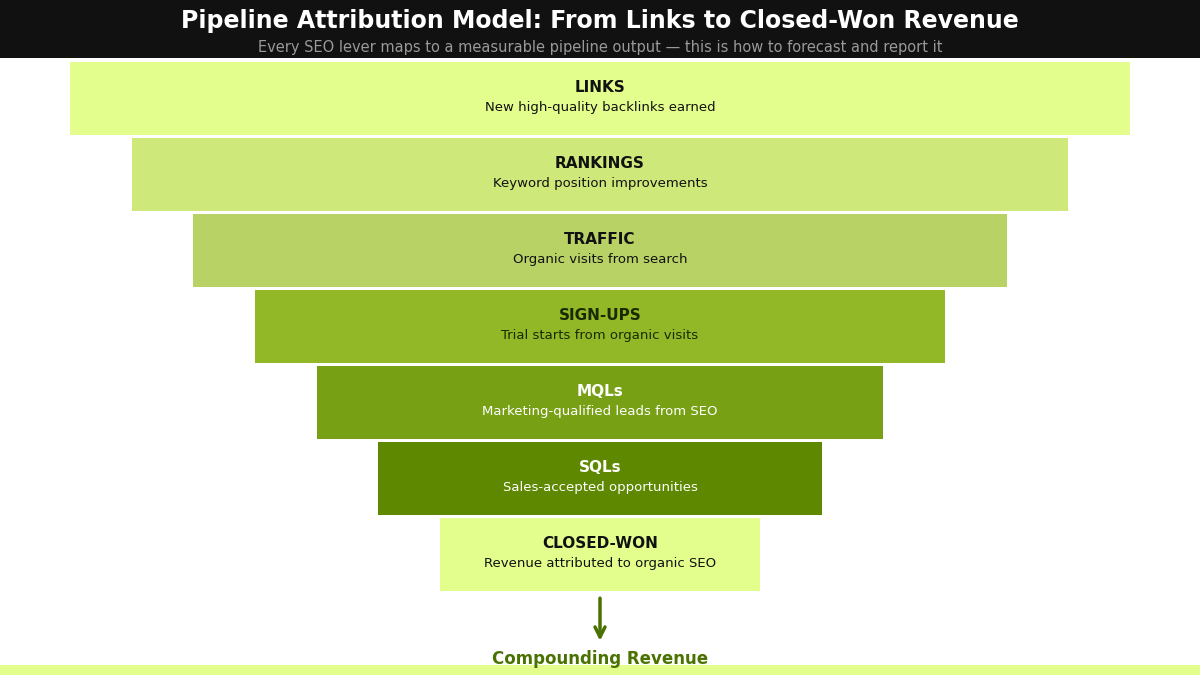
This kind of modeling helps you see beyond traffic spikes and gives you a realistic view of what 90-day traction and 12-month compounding might look like.
This kind of "pipeline-driven measurement" in practice is clear in what Ethical SEO achieved for SaaS client Messente.
Our SEO-driven tactics led to a 246% improvement in lead acquisition rate and nearly 90,000 organic visits per month. These results hold real value.
Once you have a forecasting model, you need a way to show it to the board in a way that they understand.
Typical components of a SaaS-focused SEO dashboard include:
Board-ready dashboards turn SEO from a black-box into a transparent, pipeline-driven lever that leadership can plan around.
If you're used to paid channels, SaaS SEO can feel painfully slow. You don't flip a switch and see results overnight. But when it's structured correctly, it can compound in ways no paid channel will.
The key is setting clear expectations across different phases, from early technical wins to long-term pipeline growth. The ranges below depend on your starting point, competition, and consistency of execution.
This framework positions SEO as a compounding growth channel, and not a short-term traffic-spiking experiment, making it easier to align with leadership expectations and long-term planning.
For many SaaS companies, the real question isn't whether to do SEO, but who should run it.
You can run SEO in-house, outsource it, or use a hybrid model depending on your team's expertise and bandwidth. In most cases, agencies are brought in to fill certain gaps like technical SEO, link-building, and pipeline-focused reporting.
In practice, many SaaS companies combine internal ownership with external support for specialized execution.
If you do decide to bring in an agency, it's worth being selective. Generic SEO agencies usually don't understand SaaS-specific nuances.
When evaluating SaaS-focused SEO partners, look for:
If an agency can demonstrate all four, you're likely on your way to a great partnership.
You're way past the point of SEO being an abstract "growth idea." You've seen the 5-phase SaaS SEO strategy, how it maps to 2026-specific shifts, and where most programs fail to move pipeline. The next step is to turn that into actual momentum.
For SaaS companies with the right profile (20 to 200+ employees, Series A+ funding, $5,000+ monthly SEO/content budget, and B2B sales cycles longer than 14 days), the next move is usually one of three things:
Before you scale content or links, run a quick internal audit to see where your biggest leaks are. Here’s a basic checklist you can use:
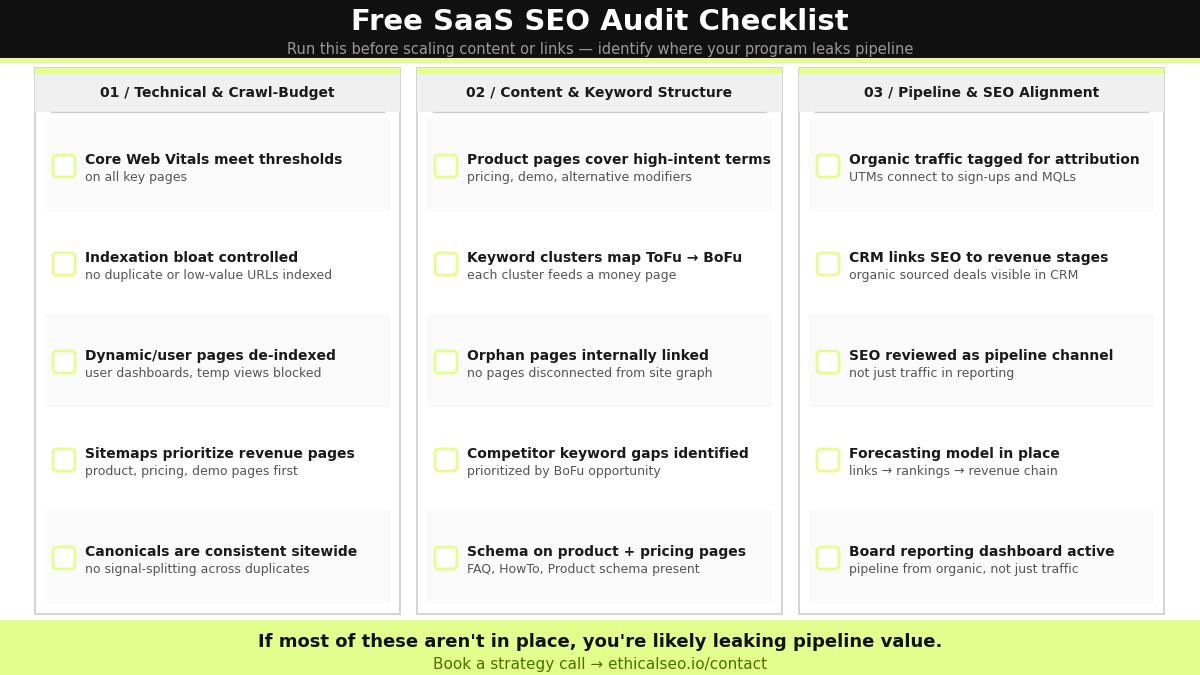
If you’re already investing in SEO but not seeing clear pipeline impact, or if you’re post-funding and under pressure to show predictable growth, the next logical step is a focused strategy conversation.
Through a 45-minute SaaS SEO strategy call with Ethical SEO, here's what you will get:
As your SaaS-focused SEO partner, Ethical SEO can show you how we would apply the same framework you just read about, such as technical debt fixes, funnel-mapped keyword architecture, product-led SEO, and pipeline-oriented measurement, directly to your business.

If you're leading marketing at a B2B SaaS company, you've likely been asked: "How does SEO actually drive pipeline?"
You've likely tried SEO before, or worked with an agency that promised traffic growth but didn't connect it to MQLs or revenue.
Or maybe you've stuck with paid channels because they're easier to measure, even as your customer acquisition cost (CAC) keeps climbing.
In 2026, that old playbook stops working.
This guide outlines a SaaS-specific SEO framework designed for product-led growth (PLG) funnels and AI-driven search. The focus is simple: connecting SEO directly to sign-ups, MQLs, and pipeline growth instead of meaningless KPIs.
If you're considering investing in SEO or already spending $5,000+ per month between retainers and content, you'll walk away with a clear roadmap for how to build, audit, and scale a SaaS-focused SEO program that delivers predictable pipeline growth.
At its core, SaaS SEO is a pipeline-driven way to use search and AI-driven answers to attract, qualify, and convert the right SaaS buyers.
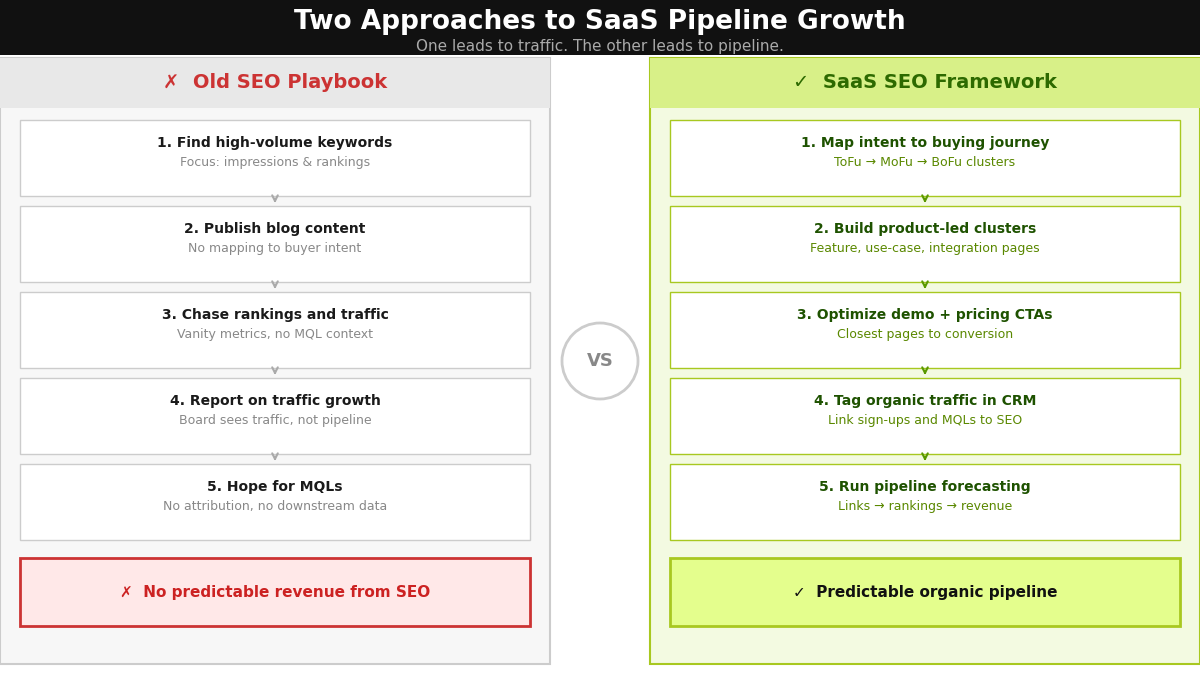
Unlike generic SEO playbooks that stop at "find keywords, write content, track rankings, and chase traffic," SaaS SEO connects keyword research, technical infrastructure, and content structure to actual sign-ups, MQLs, and revenue.
For SaaS companies in 2026, that also means designing for how people actually search today: through AI Overviews (AIOs), PLG funnels, and large-language models (LLMs). A strong SaaS SEO strategy is less about vanity metrics and more about whether organic and AI-driven visibility reliably feeds your pipeline over time.
Let's look at what actually makes this different from the standard SEO playbook.
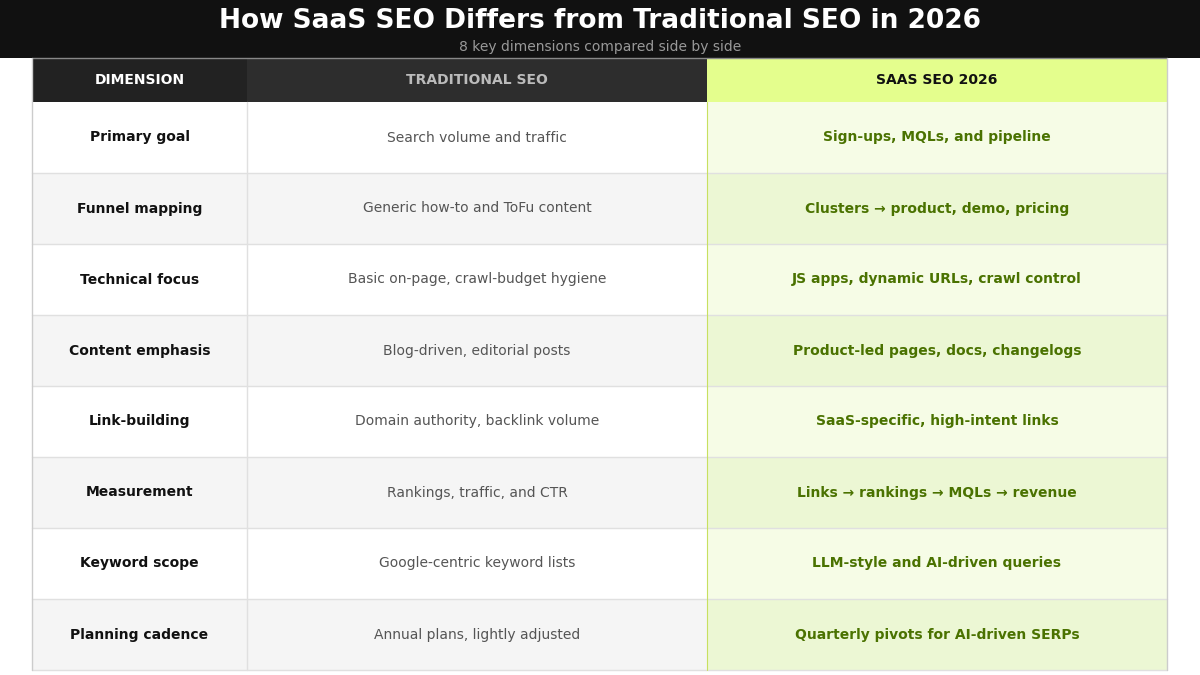
Traditional SEO often focuses on finding high-volume keywords, publishing as much content as possible, and tracking rankings and traffic improvements.
SaaS SEO, on the other hand, prioritizes pipeline-aligned clusters that map top-of-funnel awareness to bottom-of-funnel conversions (ToFu → BoFu). Here's how the two approaches compare in practice.
In 2026, SaaS SEO can't look like the generic playbook from 2022. The environment around search, buying behaviour, and growth expectations has shifted enough that repeating those tactics just leaks value.
A report by Gartner predicts that traditional search volume will drop by 25% by 2026 due to AI chatbots and other virtual agents.
This means a significant chunk of ToFu discovery is moving away from traditional rankings. AI tools and LLMs like ChatGPT, Gemini, and Perplexity now surface answers directly, so fewer users click through to websites at all.
At the same time, product-led growth companies are capturing more organic leads via optimized feature pages than their blog-heavy rivals.
PLG-style SaaS businesses treat changelogs, release notes, and onboarding flows as lead-gen assets, not just supporting content.
And AIOs consolidate informational traffic onto a shrinking set of authoritative domains, which widens the authority gap for companies that put off structured SEO programs.
As customer acquisition cost rises, organic needs to function as a true pipeline channel. The companies that treat SEO as a pipeline-driven, long-term engine, rather than a short-term traffic lever, are the ones that end up owning category-defining keywords.
There are several potential challenges that come with trying to boost AI search visibility and its subsequent impact.
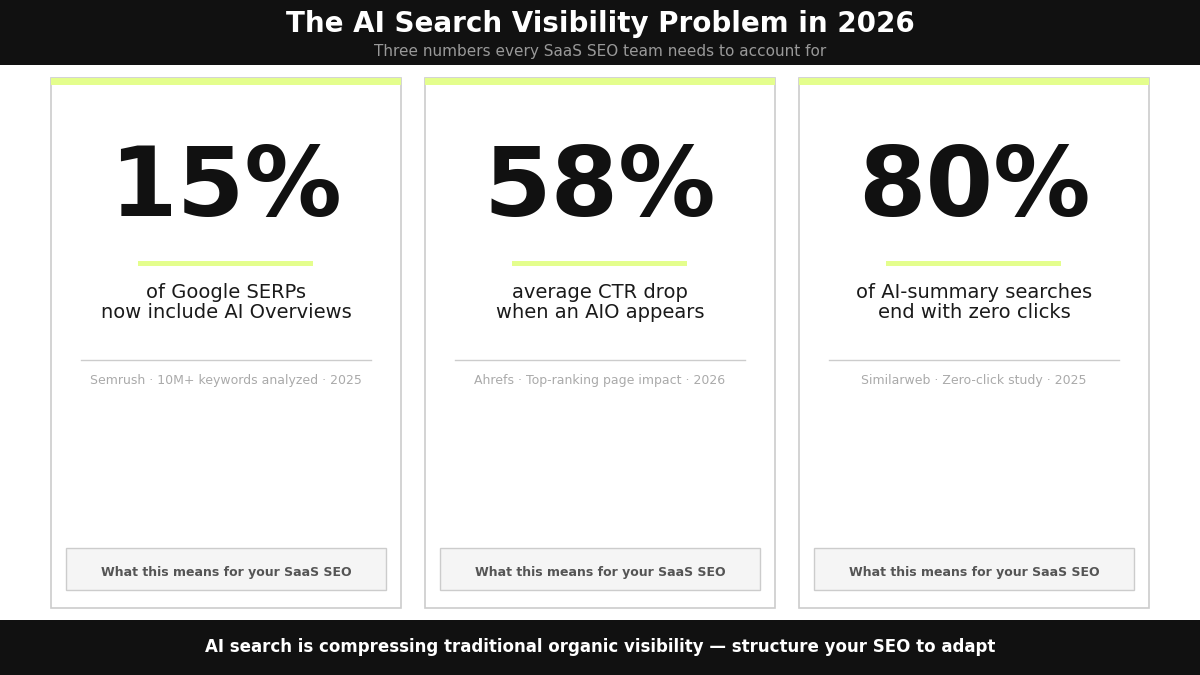
A large-scale Semrush study analyzing 10+ million keywords found that AI Overviews appeared in around 15% of Google search results by late 2025, and that share continues to grow as Google expands AI-driven experiences.
And when AI tools appear, their impact on organic traffic is significant. A fresh 2026 study by Ahrefs shows that organic click-through rate drops by about 58% on average for top-ranking pages if an AIO pops up.
At the same time, advertising is rapidly creeping into AI-driven SERP spaces.
A report published by Semrush in February 2026 found that in October 2025, Google ads started appearing on roughly 25.5% of SERPs that include an AI Overview, up from about 5% in March 2025, a jump of nearly 400% in under a year.
Another problem AI-powered summaries have given rise to is a higher prevalence of zero-click behaviour. Recent analysis by Similarweb revealed that on average, 80% of searches with AI summaries end up being zero-click.
Beyond traffic impact, visibility itself is unstable.
AI-generated citations fluctuate frequently; thus, a certain brand's visibility in AI results can't be reliably captured by single snapshots of query logs. Rankings alone no longer guarantee consistent presence in AI-driven answers. This makes structured, authoritative content more important than ever.
Product-led growth (PLG) has shifted SaaS SEO from homepage-driven acquisition to product-level conversion.
Instead of relying on blog traffic, high-performing SaaS teams turn feature pages, integrations, changelogs, and documentation into acquisition assets.
This shifts SEO from a "blog-first" model to one that's baked into the product experience. Visitors landing on feature or integration pages are often closer to trial decisions, making these pages more conversion-efficient than generic traffic.
Another important aspect is aligning SEO-driven traffic with smooth self-serve pricing and sign-up flows. A case study by SEO Juice covering a Series C SaaS CRM revealed that roughly 50% of their organic drop-offs were happening at pricing friction points.
SEO success increasingly depends on how well your product surfaces are structured to capture and convert search demand.
Customer acquisition cost continues to rise across paid channels, pushing SaaS companies to look for more sustainable pipeline sources.
Many teams still invest in content without fixing technical issues, measure traffic instead of pipeline, and use generic playbooks that ignore SaaS funnels. This leads to underperformance and over-reliance on paid acquisition.
In 2026, effective SaaS SEO treats organic as a pipeline channel: structured, measurable, and directly tied to MQLs, SQLs, and revenue.
If you're investing in SEO right now and your board still isn't sure whether it's actually moving pipeline, you're not alone.
Many SaaS teams pour money into content, links, and tools, only to see modest traffic bumps and vague "ranking improvements" that don't translate into sign-ups or MQLs.
Usually, the problem isn’t that SEO doesn’t work. It’s that the program is built around the wrong metrics, the wrong playbook, and the wrong assumptions about how SaaS actually buys and how traditional and AI search actually work.
Let's break down the most common reasons SaaS SEO programs fail to drive real revenue, before we get into how to fix them.
A lot of SaaS SEO reporting still looks like it was designed for a 2018 agency pitch deck. Many teams still obsess over impressions without conversion tracking, rankings without pipeline context, and traffic growth without sign-up attribution.
This creates misleading wins where traffic grows but sign-ups and MQLs stagnate.
The core issue is a lack of downstream tracking across the full funnel:
Page view → Sign-up → MQL → SQL → Revenue
Without that connection, SEO becomes a reporting exercise rather than a pipeline driver.
A lot of SaaS SEO still runs on template-style playbooks borrowed from ecommerce or generic B2B content marketing. Those playbooks rarely account for freemium or PLG funnels, long nonlinear buying cycles, or product-driven conversion paths.
The result is predictable: blog-heavy strategies that ignore product pages, feature pages, and documentation as SEO assets; keyword lists without high-intent modifiers (like "free trial," "pricing," "integrations," or "alternative to [competitor]"); and link-building focused on low-value content.
When SEO isn’t aligned with how SaaS buyers actually evaluate and adopt products, it rarely translates into pipeline, even if activity looks high.
Many SaaS SEO programs treat technical SEO as a one-off audit instead of a continuous layer. That's where the leaks start.
Common patterns include
- Scaling content before fixing Core Web Vitals
- Building links to pages with canonical issues or indexation bloat
- Delaying schema implementation until after content is produced
- Adding international pages without proper hreflang configuration, and
- Failing mobile-first indexing checks on high-intent feature pages.
In SaaS, technical debt hits where it hurts most: product pages, feature pages, and pricing pages. If those pages sit behind rendering barriers, duplicate URLs, or slow-loading experiences, no amount of high-quality content or "top-tier" links will save them.
Lots of SaaS teams publish content constantly, but that volume doesn't compound if the underlying structure is weak.
Issues include:
- Random blog posts that don't fit into clear topic clusters,
- No clear ToFu → MoFu → BoFu linking framework,
- Orphan pages that sit isolated from the rest of the site,
- Missing schema on key pages, and
- Inconsistent publishing frequency that erodes algorithmic trust signals.
Unstructured content, even if it’s high-quality, just becomes noise.
In many SaaS companies, SEO operates in the shadow of paid marketing. Teams funnel budget into ads because they're measurable in the short term, while SEO gets treated as a "nice-to-have" that can be scaled back or defunded when budgets tighten.
This creates a few big problems:
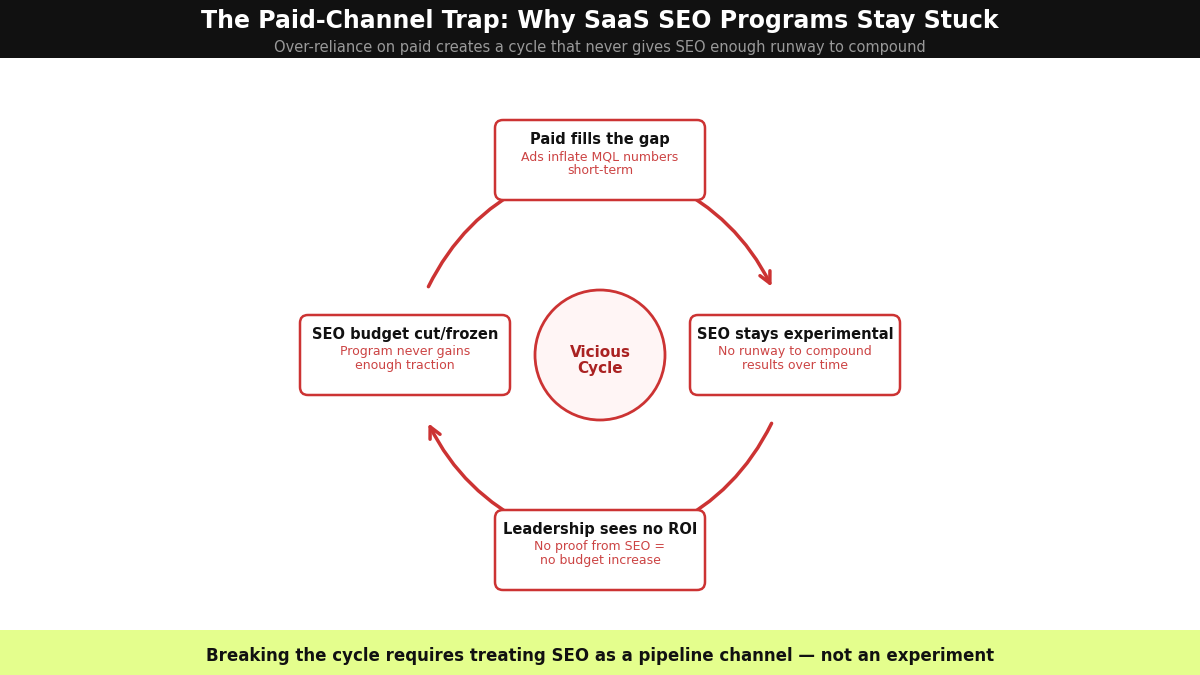
The result is a vicious cycle: paid fills the gap, SEO stays experimental, and leadership never sees enough from SEO to justify treating it as a core pipeline channel.