


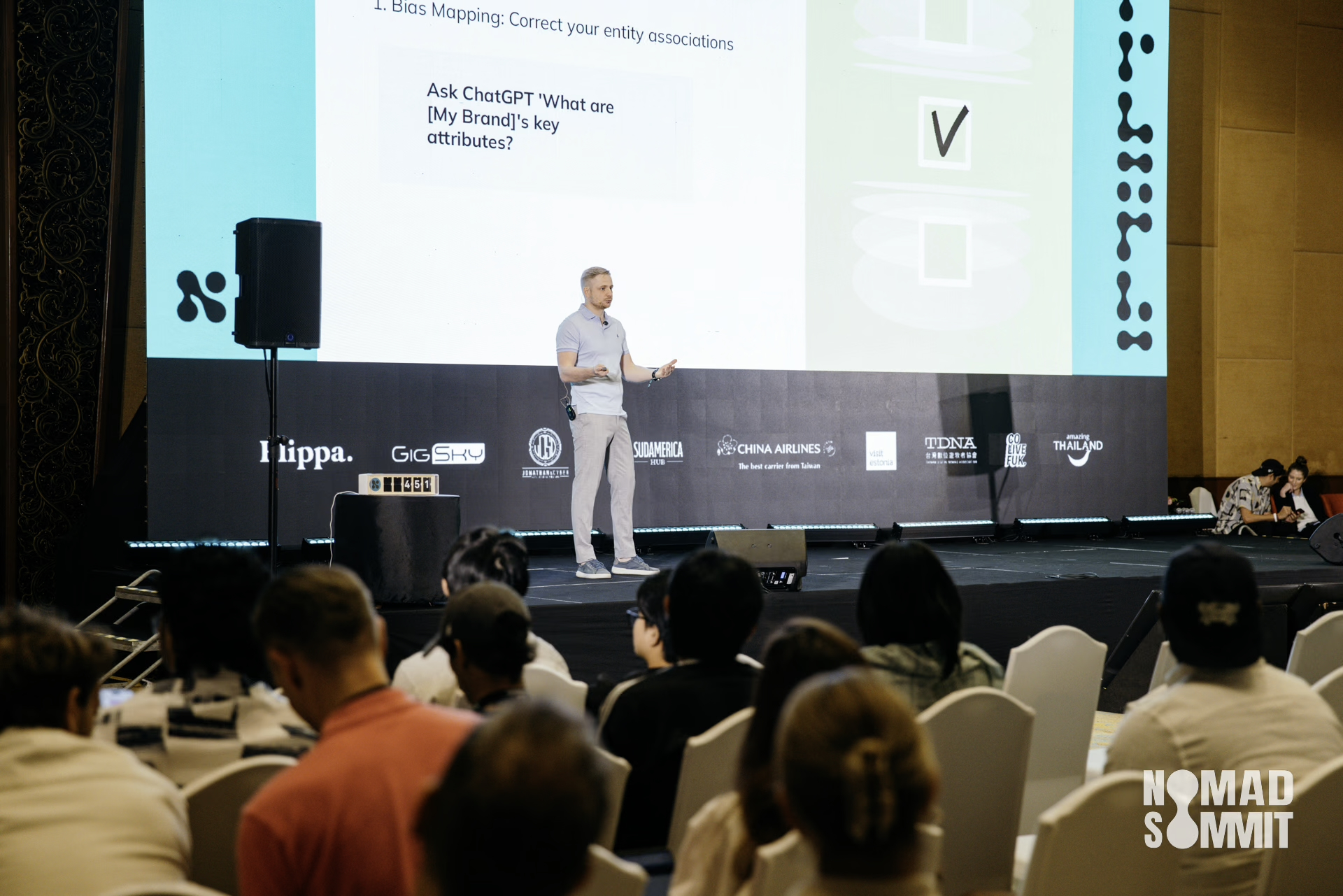
I recently presented at the Nomad Summit in Chiang Mai about the future of search.
The conversation centered on one uncomfortable truth of how for twenty years, marketers chased one metric: the click. You optimized a page, ranked in the top ten blue links, and waited for users to click through to your website.
That game is over.
Right now, 60% of search experiences end with zero clicks. Users are not looking for a list of links. They are looking for an answer. If you only exist as a source link at the bottom of an AI summary, you are invisible. To survive the shift to AI search, you must become the answer itself.
By 2028, forecasts suggest 75% of search revenue will be driven by AI. This does not mean AI will pull out a credit card and buy your product. It means three out of four customers will ask an AI for a recommendation before they ever open their wallets.
Most businesses have not noticed this shift. The AI search landscape is fragmented. Each platform has different rules for citation and visibility.
Google AI Overviews push information directly in front of the user.
The goal is simple: be the definition.
If someone searches for "nomad visa income requirements," AI looks for the most direct, factual answer. If your article starts with a generic introduction about the joys of traveling, the AI will skip you. Write specific definitions in the opening sentence.
Tools like Gemini and ChatGPT are built for deeper discussions.
This is where the "fan-out" strategy works. If a user wants a Portuguese D7 visa, a standard writer lists the five requirements.
A professional who understands LLMs anticipates the follow-up questions: Do I become a tax resident? Can I bring my spouse? Answer the entire cluster of questions, and you increase your chances of earning a brand mention.
Perplexity is a citation-first search engine. It relies heavily on traditional authority. Studies show Perplexity has a 91% overlap with Google's top search results. If you want to rank here, you must be the primary data source.
Many marketers believe ChatGPT will destroy Google. I disagree.
LLMs only know what we tell them or what third-party data we integrate. Google owns our digital lives. They know where you sleep because of Google Maps.
They know what flights you take because of Gmail. They know what you watch on YouTube and what you buy with Google Pay.
In the search engine wars, the winner is the company with the most data.
Think of a traditional search engine as a librarian. You ask a question, and the librarian brings you ten books. You have to read them to find the answer.
An LLM is an analyst. You ask a question, and the analyst reads hundreds of books, summarizes the data, and gives you the exact answer.
You no longer need to trick the librarian. You need to ensure the analyst finds your book first, and you need your brand mentioned inside the most important books on the shelf.
AI uses vector embeddings to understand text. It measures the mathematical distance between concepts. To an AI, words are just coordinates on a 3D map. "King minus man plus woman equals queen."

AI processing costs money. These systems have token limitations. If you want to be visible, you must structure your content for machine readability.
You need to change how you publish content today. The SaaS SEO strategy that works comes from understanding how AI systems extract and rank information. Here are the core tactics that drive results.
Research shows 44.2% of all ChatGPT citations come from the first 30% of content. Do not bury your main point at the bottom.
Answer the core question in the first paragraph. When you optimize your content structure for LLMs, this principle becomes the foundation of everything else.
AI prefers easily extractable data. If you are writing a product review or a pricing comparison, do not hide the details in a paragraph.
Put the data in a table. When AI pulls your table to show a user, it links back to you. Structured data markup helps AI systems understand your information more clearly.
Divide your articles into clear chunks. Each paragraph should target one specific idea with a clear heading.
If you mix multiple concepts into a single paragraph, you confuse the mathematical models trying to map your content. This is core to what we call semantic SEO, where meaning matters more than keywords.

Stop writing fluff. Every 500 words, include a specific fact.
Do not say "the weather is hot." Say "the average temperature is 32 degrees."
AI prioritizes information gain. It looks for new data it has not seen before.
Freshness matters.
Content updated every three months gets cited 20% to 30% more often.
Instead of publishing ten new articles per month, update your best existing article. This approach aligns with content maintenance strategies that focus on quality over quantity.
You cannot wait for AI to discover your website. You must place your brand where LLMs collect training data.
Reddit is trusted by AI models because it represents human consensus. YouTube transcripts are weighted heavily. Quora provides data across 28 languages.
The easiest win is the listicle.
Write an article like "Top 10 Solutions for Digital Nomads" and publish it on a reputable third-party site.
You do not need a backlink. You only need the brand mention.
When users ask AI for a recommendation, the AI reads that listicle and suggests your brand. This tactic is part of what we call generative engine optimization, which focuses on visibility in AI-powered search.

Attribution in the AI era is broken. We call it the dark funnel.
A user asks ChatGPT for a recommendation, sees your brand, opens a new tab, and searches for your company directly. Your analytics dashboard records this as "direct traffic" or a "branded search." You have no idea the AI drove the sale.
Many companies spend hundreds of thousands of dollars on software that tracks brand visibility in LLMs via API connections.
These tools are vanity metrics. The results generated through an API differ completely from what a real user sees. If a user changes one word in their prompt, the entire output changes.
The most secure way to measure AI traffic is self-attribution.
Add a required field to your contact forms: "How did you hear about us?" Let users tell you directly. This gives you real data about AI-driven traffic attribution without relying on third-party tools.
Now let's move from theory to practice. If you're running a solopreneur business or a small team, here are the tactical items you need to implement immediately.
Hallucination is when an LLM provides wrong information about your brand. You can test this directly by prompting an AI with questions like "What are my brand's key attributes?" If ChatGPT says you're a cheap product when you're premium, you have a problem.
Find the sources AI is citing, go to those pages, and adjust the copy.
One well-known SEO software CEO recently shared that they found their top-ranked source page in LLMs was an outdated blog post about their pricing.
Users asked about pricing, saw outdated information, and got frustrated. This bias and hallucination problem is critical to address.
Do not make generic page titles or headers. Be specific and include your main keywords in the first 40 characters of your title tags and H1s. This leads to better results in both AI systems and traditional search.
For both LLMs and user experience, include a reference to the author. Do not write articles anonymously. Prove that you are a real human expert.
If you have awards or badges, put them at the top of the page. Remember that AI is lazy. It might not scroll down to find your credentials if you didn't prioritize them.
Register on G2, Capterra, Clutch, Trustpilot, and similar review platforms. These sites appear in LLM training data. When AI systems look for social proof, they find these reviews. This is one of the highest-ROI activities for solopreneurs.
If you have limited resources, prioritize Reddit and Quora. Quora is translated into 28 languages, giving you global reach. These platforms are heavily weighted by AI systems because they represent real human discussions and recommendations.

We are preparing for this because search is evolving into action. Soon, you will not search for running shoes. You will tell your AI assistant your size and budget, and the AI will browse websites, buy the shoes, and arrange delivery on your behalf.
For twenty years, we were told to write content for humans. Now, we write content for machines so the machines recommend us to humans.
Do not let fear keep you hidden. Optimize your structure, state your facts clearly, and make sure your brand is part of the answer.
That is how you win in 2026.


